

A WEEK IN BANGKOKCITY OF TOWERS AND TEMPLES, MALLS AND MARKETSFor first time travellers to BangkokElizabeth Handley’s travel piece on this fascinating country is required reading!– PART ONE – |
Travel across time zones always leaves one feeling dazed and bemused. It’s a surreal experience arriving in a new city many hours ahead of, or behind, one’s point of departure. This is especially true of arrival from ordered and pristine Scandinavia to the comparative chaos and bustle of Southeast Asia. After the crisp dryness of wintery Stockholm and then Amsterdam (with KLM), Bangkok was as steamy and sultry as word and literature had lead me to expect. Although still very early in Europe, it was already morning when I arrived, and the day in full frenetic swing. Nothing had prepared me for such vibrancy – the bright colours, din, and smells – both foul and fragrant.
One morning, early, we crossed the bar, and while the sun was rising splendidly over the flat spaces of the land we steamed up the innumerable bends, passed under the shadow of the great gilt pagoda, and reached the outskirts of the town. There it was, spread largely on both banks, the Oriental capital which had as yet suffered no white conqueror. Joseph Conrad: The Shadow Line (1917)
The flight from Stockholm to Amsterdam takes 2 hours, followed by the long haul to Bangkok of a further 11½ hours (12½ hours on the return trip.) The captain informed us that our journey would take us over Eastern Europe, Turkey, Turkmenistan, Afghanistan, India and Burma. With a 6-hour time difference, night came and went rapidly, and it was already dawn by the time we traversed the snow-capped peaks of the mighty Hindu Kush.
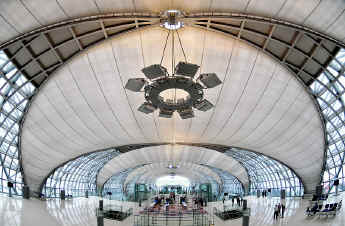
Arrival in Suvarnabhumi International Airport is a reasonably well-organised business, as is the queuing system for a taxi. (South Africans don’t need a visa for a stay of up to 30 days.) Once outside, the heat and humidity hits one like a muggy claustrophobic blanket.
A taxi, mercifully air-conditioned, is the simplest mode of transport into the city, and fairly cheap (280 THB, R93.) Several queues of visitors are channeled to a central makeshift desk, where the destination is written on a slip of paper and given to a driver.
A slow, bumper-to-bumper ride to the Landmark Hotel (used by Peter on his frequent business trips) in Sukhumvit Road, gave me ample opportunity to absorb my new and exotic surroundings: several reed-filled marshes and verdant tracts of tropical jungle bursting with oleander and bougainvillea. Closer to the city, rusty-roofed warehouses and rows of tiny dilapidated stalls secured with ancient trellises come into view. Overhead loom massive billboards advertising cars, banks, Samsung Galaxy, Bangkok Airlines, and Triumph bikinis – in Thai and English. Occasionally, through the rumble of the taxi’s cantankerous air conditioner, strange birdcalls filtered through from the abundant foliage flanking the highway. Here and there stand minaretted mosques, Islam being the second religion in Thailand after Buddhism. (Muslim women there cover their heads, but are not veiled.)
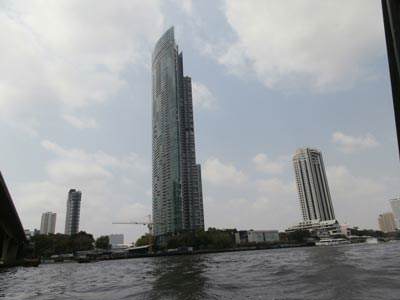
As we inched our way through two tolls (each 50 THB, paid by the passenger), and passed beneath several bridges decorated with ornate Thai gables, the impressive Bangkok skyline gradually emerged through the muggy haze ahead: a vast panorama of concrete-and-glass skyscrapers bristling with masts and Oriental pinnacles.
Coming into the city there are many familiar logos: DHL, MacDonald’s, Subway, Boots, 7Eleven, Starbucks and KFC. Brightly-coloured taxis – yellow and green, blue, and dayglo pink – tuc-tucs and scooters weave at breakneck speed through the sluggish traffic, while overhead the streets are festooned with a tangled network of wires and cables, reminiscent of those in Stone Town, Tijuana and Arusha. Even the busses are bright pink. The sense of urgency is heightened by the rumble of the overhead Skytrains, impatient hooting, and the shrill whistles of the traffic police.
“Bangkok! I thrilled. I had been six years at sea, but had only seen Melbourne and Sydney, very good places, charming places in the way – but Bangkok! Joseph Conrad Youth (1888).”
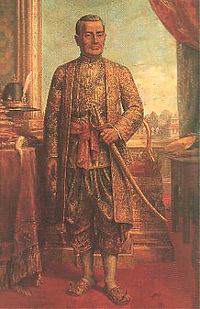
bangkok is not an ancient city. It was founded in 1782 by King Rama I (r.1782 – 1809) at a customs post on a strategic bend in the Chao Phraya River. This island settlement was originally called Bang Ko (island village) or Bang Makok (Place of Olive Plums), and is surrounded by a network of canals, the original means of transportation. Later, with the addition of palaces and temples in the classical Thai style, and impressive wooden mansions, this village soon became the fastest-growing metropolis in Southeast Asia.
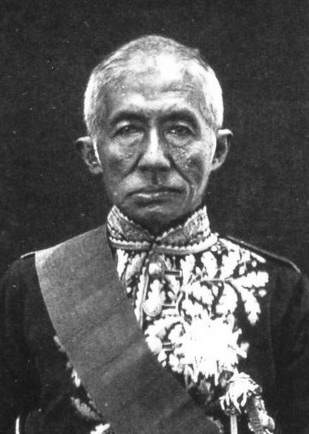
King Mongkut of Siam
During the mid-19th century, King Mongkut (Rama IV, of The King and I fame – a film banned in Thailand as disrespectful towards the monarchy) signed several international trade agreements which set Bangkok’s rapid commercialisation and modernisation along predominantly Western lines.
Today it is a megapolis of over 12 million people, a thriving modern city in which great contrasts are immediately visible to the newly-arrived traveler: mouldering concrete tenements and rotting riverside shanties alongside ornate temples and palaces, ancient beliefs and superstition alongside modern technology, and chic shoppers who side-step filthy beggars.
“Bangkok” is thus known only in English. In Thai, it is often called Krung Thep Maka Nakhon, or simply Krung Thep. Its full name is Krung Thep Mahanakhon Amon Rattanakosin Mahinthara Ayuthaya Mahadilok Phop Noppharat Ratchathani Burirom Udomratchaniwet Mahasathan Amon Piman Awatan Sathit Sakkathattiya Witsanukam Prasit. (“The city of angels, the great city, the residence of the Emerald Buddha, the impregnable city (unlike Ayutthaya) of God Indra, the grand capital of the world endowed with nine precious gems, the happy city, abounding in an enormous Royal Palace that resembles the heavenly abode where reigns the reincarnated god, a city given by Indra and built by Vishnukarn.”)
Wandering through the city along the busy uneven sidewalks is a fascinating experience – provided that you watch out for motorbikes that come unexpectedly across your path. There are the usual brand-name shops, interspersed with tiny shabby cafés and stalls selling anything from Chinese medicine to electronic goods, groceries, antiques, Thai crafts, books, and cheap cotton clothing. There are those selling suitcases and backpacks, and bags and shoes – especially those made from crocodile skin, which is farmed in Thailand. Jewellry shops range from the Asian equivalents of Accessorize selling cheap plastic and metallic bling, to gold stores displaying a glittering array of chains, and glass cases filled with rings, earrings and pendants, most of which bear images of Buddha or the current King.
Buddhism is an integral part of life in Thailand, and a constant and conspicuous presence. The prevailing branch is Theravada Buddhism, which is based on the ancient Pali canon of Buddha’s teachings, the Tripitaka. Thai Buddhism incorporates many Hindu, Tantric and Mahayana Buddhist practices, some of which were brought to the region from around the 3rd century BC. Buddha literally means “one who is enlightened”.
Merit-making is part of the practice of Buddhism, and can take the form of any good deed, from the application of gold leaf to Buddha images, wats and murals, to giving alms to monks.
Most Thai males are ordained as monks in adolescence – a major right of passage – and a means of making merit. (Few Thai women become nuns). A common sight in the city are groups of clean-shaven Buddhist monks, clad in bright saffron robes, wandering around seeking alms. Children are taught the simple moral codes of Buddhism from an early age, and senior monks are asked to give blessings at child-naming ceremonies, weddings, or to a new house, car or business venture, or even a Thai Airways jumbo jet.
Ritualistic tattooing is an ancient Hindu-Buddhist custom, as such body artwork is believed to ward off unwanted negative powers.
Buddhism is one of the three forces, Thais believe, that give their kingdom strength; the other two being monarchy and nationhood. These three concepts are inextricably linked. Even King Bhumibol Adulyadej (Rama IX) spent time as a monk, thus reinforcing the notion that Buddhism and monarchy are unified powers. Throughout its 700 years of independence, the Kingdom has enjoyed noteworthy continuity, underpinned by Buddhism – the national religion. The monarchy, which has been constitutional since 1932, is as deeply revered now as it was in the days when kings were literally “Lords of Life”.
Everywhere you turn there are shrines and spirit houses, all bedecked with garlands of bright yellow chrysanthemums and other exotic flowers, bowls of rice and fruit, plastic figurines of mythological characters, and sweetly-scented incense. Almost every business and home sports a shrine at the entrance, intended to bring good custom and fortune, and to keep marauding evil spirits at bay. Garlands of heavily-scented jasmine symbolise the beauty of the Buddha’s teachings, and, as it fades, represents the transience of life.
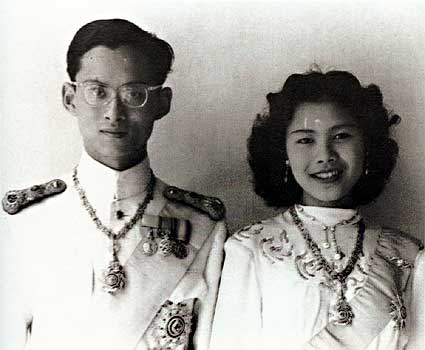
Equally prevalent are portraits of the King, now 87 years old (r. 1946 – ). He is already known as “the Great”, and is sometimes pictured with Queen Sirikit. Royal portraits adorn shops, Skytrain stations, hotel lobbies, park notice boards and massive overhead billboards. His Majesty is always depicted unsmiling, with large spectacles, clad in a magnificent robe embroidered with gold thread, and Her Majesty smiling gently, her head tilted charmingly to one side. His Majesty’s head appears on every coin and bank note, and some stamps.
Linked to Thai Buddhism is the all-pervasive superstition. Everyone wears amulets to safeguard against evil spirits, or to bring good luck. The rear-view mirror of taxis, tuc-tucs and ferries are slung with prakham (prayer beads), and talismans. There are auspicious colours, images and numbers, such as the best day to move into a new abode, launch a business venture, get married or buy a car – and which colour it should be. There are deities such as Nang Kwak, who brings luck to businesses and attracts customers, and Pho Sop, the rice goddess of Thailand. And there are ghosts, generically known as Phi – harmless and malicious – which inhabit mountains, forest glades, trees, some houses, and burial grounds.
Folk tales and legends are used by the elders to teach wisdom to the younger generation – usually containing moral lessons – such as reverence towards adults, parents and superiors, caution, honesty, and respect.
The magnificent Wats (temples) are further evidence of a culture heavily imbued with the Buddhist faith, and no trip to Bangkok would be complete without a visit to at least three of the principle Wats on the “Top Ten” list of sights.
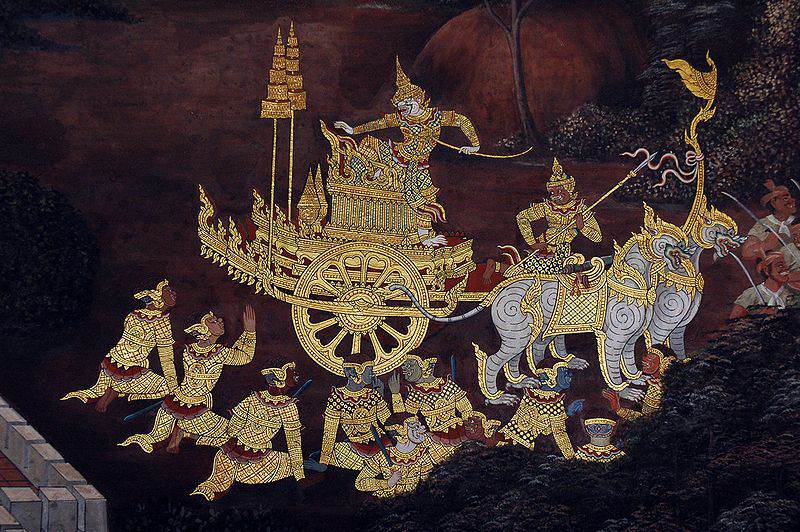
Wat Phra Keaw Ramayana Chariot
Emerald Buddha
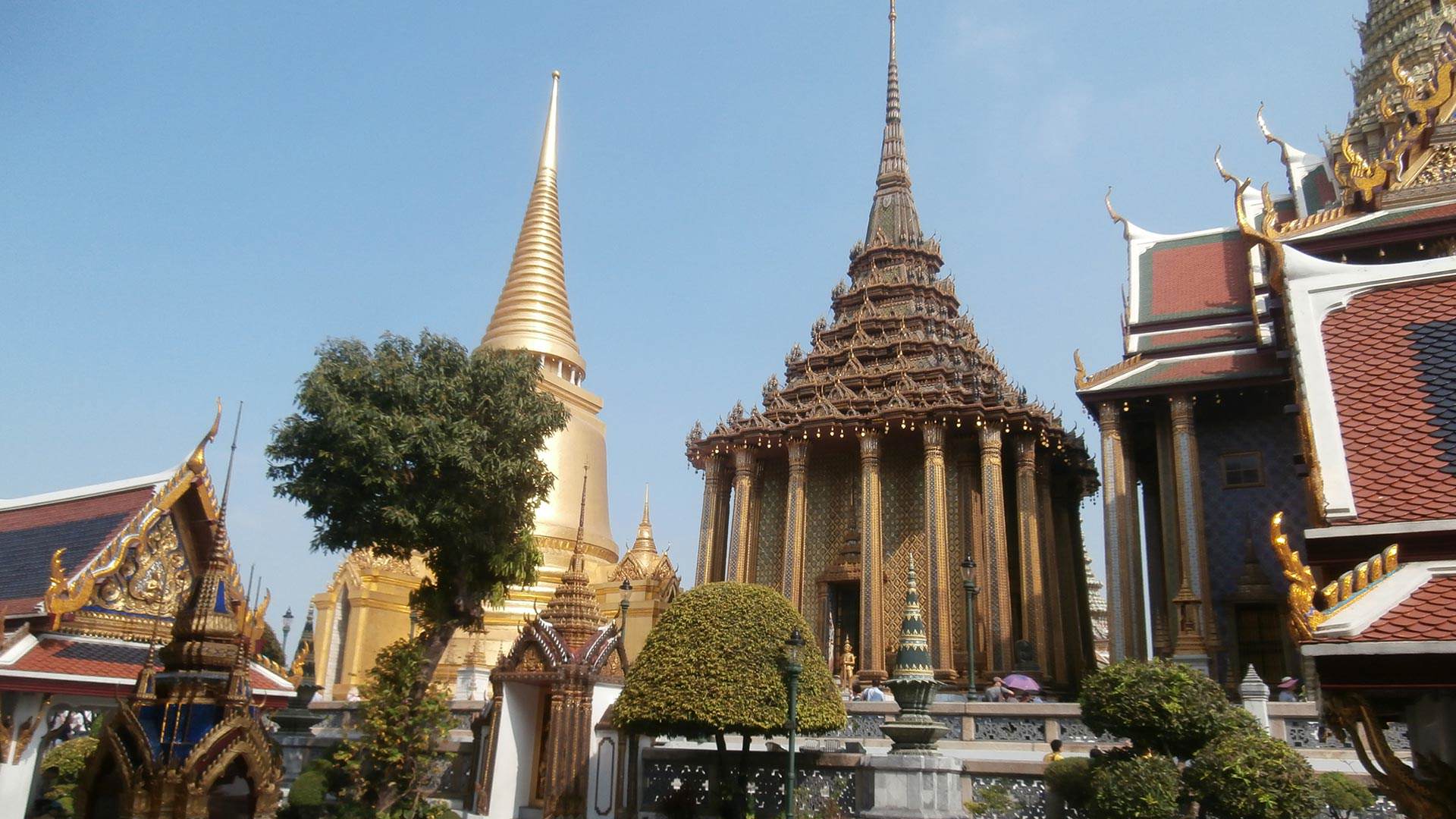
Chief among these are Wat Phra Kaew – the final resting place (after many exciting adventures) of the Emerald Buddha, which lies within the Grand Palace complex, and the holiest shrine in Thailand. Construction of these buildings began in 1782 to mark the founding of the Chakri Dynasty and the new capital, which replaced the ancient one of Ayutthaya, situated 75 km further up the river, which had been destroyed by the Burmese in 1767.
The Emerald Buddha (actually made from jade) stands in small but magnificent glory at the apex of a many-tiered ornamental pyramid within the bot (ordination hall) – the most important building in the Wat. Here devotees make offerings and kneel, heads to the floor, in reverent worship.
The ornate decoration of the Wat Phra Kaew bot and surrounding buildings is impressively sumptuous. A great golden pagoda, with the Phra Si Rattana Chedi, contains a piece of the Buddha’s breastbone, and green and blue glass mosaic adorns the exterior of the library, wherein valuable holy books and manuscripts are stored. Decorative gilt figures encircle the bot, 112 garudas – mythical beasts, half-man, half-bird – holding down the nagas (serpents.)
The Ramakein Gallery, extending all around the cloisters, contains 178 magnificent and meticulously restored panels depicting the complete story of the Ramakien, the Thai version of the Indian epic Ramayana. This is a tale of the triumph of good over evil, with the virtuous hero, Rama, as the central character. These panels were painted during the 18th century, and damage caused by the humidity necessitates frequent restoration. Even as my guide Kally showed me around, several craftsmen and women were busy there, painstakingly reworking faded colourful characters, plants and animals, and applying delicate layers of gold leaf.
Guarding each gateway to the Gallery is a pair of yakshas (nature spirits), placed there by Rama II to protect the Emerald Buddha from evil spirits.
The eight prangs (conical towers) at the edge of the Temple, painted in different colours, represent the eight elements of Buddhism, and are decorated with delicate Chinese porcelain.
For Thai temple architecture see https://en.wikipedia.org/wiki/Thai_temple_art_and_architecture
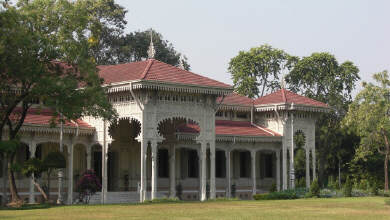
Abhisek Dusit Throne Hall
Only certain buildings of the Grand Palace may be entered by the public, and these include the fabulous Dusit Throne Hall (Sanphet Maha Prasat) – a reproduction of one of Ayuttaya’s grandest buildings. It was built in 1784, and, crowned with a magnificently decorated, tiered spire, is one of the finest examples of early Rattanakosin architecture. Inside stands the original Rama I teak throne – a masterpiece of Thai art – ornately carved, and inlaid with beautiful mother-of-pearl. This hall is used for the annual Coronation Day celebrations.
Also within the Wat and Grand Palace compound is the Queen Sirikit Museum of Textiles. The Museum (nine years in the making) has large display cases with mannequins clad in many of the Queen’s beautiful designer ensembles created for various state occasions. The displays are accompanied by video screenings of these occasions, depicting the Queen and her entourage wearing these lovely costumes. The beautiful glossy brochures inform visitors that the Museum tells the story of Her Majesty’s creation, in the 1960’s, of a new national dress for Thai women, through the presentation of historic court textiles, archival photographs and film, and more than thirty glittering examples from Her Majesty’s own wardrobe. As a result of their travels around rural Thailand, begun in 1955, Their Majesties came to appreciate how difficult it was for farmers to support themselves [with subsistence farming], especially in the face of natural disasters.
Her Majesty determined that weaving could provide a crucial secondary source of income for the women, and ensure the survival of Thailand’s unique textile heritage. Using archival footage, historic and contemporary textiles, interviews and documentaries created especially for the museum, this exhibit tells the story of Her Majesty’s ceaseless efforts to establish and expand SUPPORT, which has provided Thai weavers with training, encouragement, materials and a ready market.
I was especially moved by a display case containing a tattered piece of fabric with a faded ancient pattern and labeled “Not even so much as a rag must be discarded” – indicative of Her Majesty’s tireless quest for ancient Thai patterns and traditional weaving styles to bring to her modern-day project.
See: https://www.thaiwaysmagazine.com/thai_article/30-02_queenmuseum/queenmuseum.html
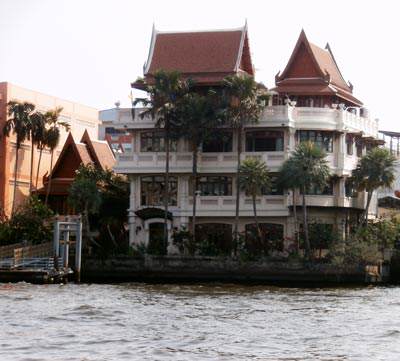
One of the most pleasant ways to see a city is from the water – a (guided) cruise on the rivers and/or canals. On the Saturday morning we took a “tourist boat” cruise up and down the Chao Phraya River (the “River of Life”) – a delightful experience offering interesting views of the city with all its quirky contrasts, and accompanied by an inaudible commentary by a guide in Thai and English.
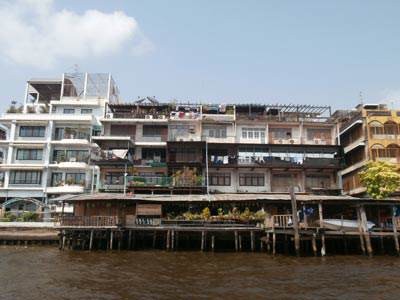 There one can see towering skyscrapers and magnificent temples, beautiful villas and crumbling tenements and shanties, picturesque markets and eateries, and fabulous hotels. (The latter include the Mandarin Oriental, Shangri-La, Peninsular, Lebua, Royal Orchid Sheraton, and theMillenium.) The Sathorn Pier is easily reached at the end of the excellent Skytrain line (Station Saphan Taksin), and boats leave to sail up and down the river every day. There are the speedy “long-tailed boats”, ferries, tourist boats and shuttles, which ferry passengers between the hotels.
The sights reached by boat include – apart from the hotels, restaurants, markets (including the Prachan Amulet Market) and Wats (especially Wat Pho, Wat Phra Kaeo and Wat Arun) – Chinatown, Holy Rosary Church, Siam Commercial Bank, the Museum of Siam, the Flower Market, Bangkok National Museum, the Royal Barge Museum and the National Theatre. Some of these sights are visible from the river, others are tucked away from the piers, and featured in the excellent tourist boat brochure.
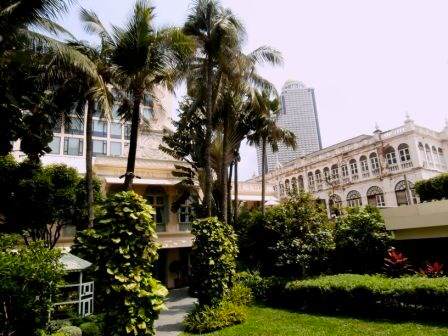
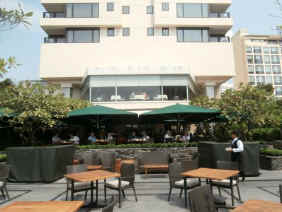
Lunch on the verandah of the old colonial-style Oriental Hotel had been recommended by a friend. Here, while enjoying a delicious meal of stir fried chicken and vegetables with tamarind sauce, we watched the passing river traffic: long barges – sometimes three, tail-to-tail – presumably taking away the city’s refuse, and other transport and pleasure boats varying in speed and size.
Many avenues and alleys in Bangkok are lined with mobile food stalls selling an array of unrecognisable wares, much of which is prepared on the spot. Street food is a vibrant aspect of the Bangkok eating culture, especially at night, when a multiplicity of makeshift stalls spring up, filling the air with delicious aromas. Apart from charcoal-grilled chicken sattays, crispy pork, squid and bananas, and jars of pickles, I saw nothing that I recognised. There were small doughy fish cakes, strings of oval-shaped sausages, and polystyrene bowls of flash-fried seafoods, all served with noodles or steamed rice with a few spoonfuls of broth.
More unusual snacks include a variety of insects: deep-fried grasshoppers, crickets,bee larvae, silkworms, ant eggs and termites. The culinary creativity even extends to naming: one tasty larva, which is also known as “bamboo worm” (non mai phai), is colloquially called “express train” (rot duan) due to its appearance. Snake curry is popular in the countryside, especially made from the king cobra. Slices of tropical fruits – durian and jackfruit (both huge spiky fruit known for their stench, but sweet custardy flavour), mango, white guava and starfruit, sold in small plastic bags – are a favourite snack. Some stalls boast marvelous displays of beautifully carved fruits, usually in the shape of flowers.
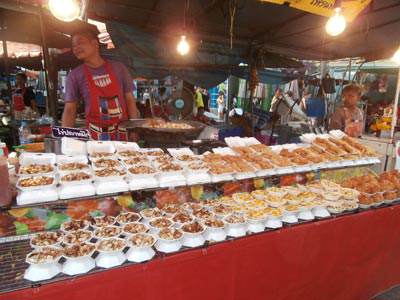
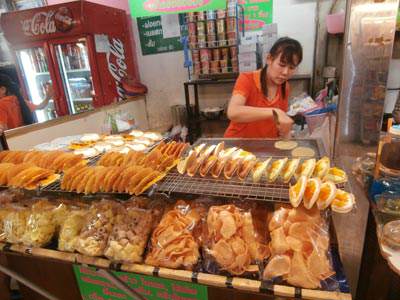
There are hundreds of delicious Thai dishes, flavoured with ginger, peanuts, lime juice, chili, fish sauce, lemongrass, bamboo shoots, tamarind, garlic and palm sugar. There are egg noodles with red pork, charcoal-roasted eggs, stuffed sweet pancakes, coconut pudding, sticky rice in banana leaves, meatballs with chili sauce, and deep-fried spring rolls.
The “national dish” is said to be Tom Yam Kung – a hot and sour shrimp broth flavoured with chili, galangal, kaffir lime leaves and lemongrass – or possibly Phad Thai (Thai fry), a delicious mix of noodles fried with fresh or dried shrimp, egg, beancurd (tofu), and bean sprouts. Stir-fried Morning Glory (Pad Pak Boon) is a deceptively innocuous vegetable dish of water spinach (Ipomoea aquatica), green beans and garlic, oyster and soy sauce, but with a mouth-burning dose of chili – for me, anyway.
For more about Thai cuisine see: https://en.wikipedia.org/wiki/Thai_cuisine
The Thai approach to eating is simple, little, and often, and usually only when hungry. There is no real concept of three meals a day. Food is eaten with a fork and spoon, or chopsticks, as meat and vegetables are shredded or cubed during preparation and a knife is not necessary. Essentially a communal affair, served from several bowls, eating is a frequent, relaxed and sociable activity – hence my impression that the Thais seemed always to be eating.
It was at one of the numerous stalls opposite the Grand Palace that Kally and I had a simple lunch of fish balls in a spicy vegetable broth, accompanied by crispy, deep-fried wafers made from rice flour and egg, and bottles of much-needed cold water.
My research before my Bangkok adventure brought to my attention the advantages and necessity of pre-booking a private guide. The city is vast, not easily traversed on foot, and the principal sights not usually reached in a logical sequence. A guide is also able to fill you in on additional interesting facts and tips not found in guide books or on the internet. Above all it is terribly hot and humid, with average daily temperatures hovering around 32°C, and a clothes-dampening torpidity. December – February are the best months to visit, when there is less heat and unpleasant heavy rain. A judiciously-planned private tour in such a climate can thus be a time and energy-saving grace.
A prior meeting with young Kally Kallinikos (her father is half Chinese, half Greek, and her mother Thai), sourced through Viator (kallyblossom@outlook.com), enabled her to plan for me a tailor-made tour which encompassed almost all the sights I wished to see, in the most pleasant manner possible. She charged a flat rate of 2300 THB (R765) for the day, which excluded lunch and all our transport costs using the Skytrain, river ferry and taxis. These are the best, cheapest and principle modes of transport in Bangkok, also favoured by the locals, and are all marvelously air-conditioned. Not so the picturesque tuc-tucs, which are speedy and more expensive, but a great deal of fun.
I also found that watching videos about Bangkok on YouTube before my trip, compiled by various tour operators, guide book companies and individuals, enabled me to ascertain the “Top Ten” and “Top 25” sights, and to choose in advance those that most appealed to my personal taste. (Eg. https://www.youtube.com/watch?v=n6VQsOvNvyQ). I drew up a list for Kally, and she advised me as to what we should see together, and what I could do on my own, and how, avoiding Monday, the day on which some attractions are closed (a common phenomenon internationally.)
Kally also advised me which areas of the city to avoid due to the on-going anti-government demonstrations. Though apparently no danger to tourists, these political activities seemed to me to have rather a festive than a menacing air, with blaring Thai pop music competing with the twangy tones of females on loudspeakers, and stalls of street food set up nearby to sustain the demonstrators. Appearing much worse on television than in reality, these demonstrations are a veritable carnival of sights, sounds and smells, in which both participants and onlookers alike appeared to be enjoying themselves immensely. Kally did, however, warn against visiting a very interesting Wat (Rachanada) due to more unpleasant demonstrations taking place nearby.
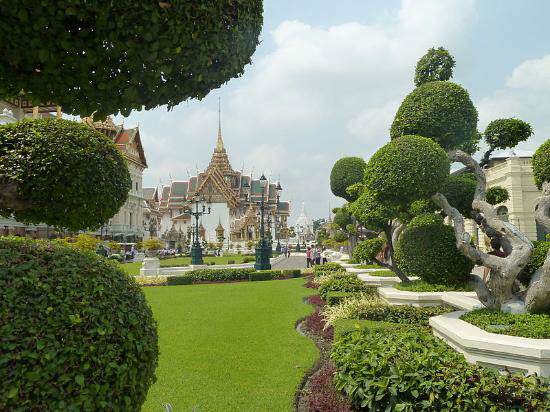
Dusit Park
After a lengthy taxi ride across town in the all-day snarled traffic for which Bangkok is notorious, we finally arrived at Dusit Park. Here King Chulalongkorn (Rama V, r.1868-1910), the first Thai sovereign to visit Europe, and who was determined to develop Bangkok in the Western style, established beautifully manicured gardens, elegant architecture and grandiose teak mansions. Interestingly, both Rama IV and Rama V were astute and far-sighted monarchs, who chose to learn from the West and modernise Siam, whilst avoiding colonization. Rama V, especially, kept avaricious Western powers at bay, thus keeping Siam free of European colonial expansionism – especially during the 19th century “Age of Colonization”. The French attempted to assert their authority over Indochina during his reign, but took over the Siam-controlled region of Laos instead.
The Royal Family no longer live in the Dusit Palace. Nowadays they reside at Chitrlada Palace: King Bhumibol Adulyadej (b.1927, Rama IX) and Queen Sirikit. They are very much beloved by the people, mostly due to their work to improve the lives of the Thais in terms of nutrition, education and health, especially in the remote rural areas.
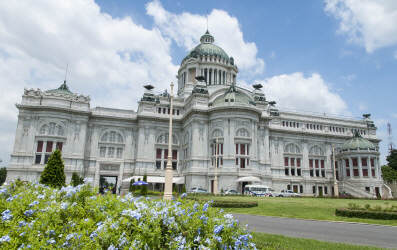
The Ananta Samakhom Throne Hall
A highlight of this area is the Ananta Samakhom Throne Hall, a magnificent white edifice, described by Lonely Planet as “an East-meets-West royal building built by King Chulalongkorn, the first Thai monarch to visit Europe. Visions of his travels must still have been swimming in his head when he commissioned the throne hall, a stunning, intricate building which, despite its Western influences, has a distinctly Thai exterior.”
Inside the Hall a number of fabulously ornate Thai treasures and works of art and royal regalia are on display: decorative thrones, palanquins and a howdah (a carriage placed upon an elephant’s back), silver-gilt models of the royal barges, and massive, intricately-woven silk (tapestry) screens. The latter display a breathtaking mastery of exquisite needlework and design; some animals, flowers and characters are raised from the flat surface by means of subtle batting stuffing, the whole creating the illusion of scenes in motion with a brilliant play of light and shade.
This building also houses another SUPPORT Museum, a vibrant symbol of Her Majesty Queen Sirikit’s initiative to revive and promote the ancient Thai craft of silk-making, dying and weaving.
Unique to Her Majesty, and a stroke of creative genius on her part much praised in the accompanying glossy brochures, is the incorporation into the fabric and designs of tiny slivers of the wings of green-blue jewel beetles (Buprestidae, also known as metallic wood-boring beetles), thus named for their glossy iridescent colours. This innovation, according to the literature, will be forever recorded in the annals of Thai artistic history, and has been extended to the wall panels and magnificent chandeliers of the Museum, which glow with a fantastic shimmering radiance.
On the lower level of the Museum is an exhibition displaying the most beautiful silk embroidered pictures, the voted best works by Thai women representing the different provinces of the country over the past several years.
The Vimanmek Mansion also stands in Dusit Park, wither we were swiftly conveyed in a golf-cart. It is a magnificent, three-storied structure resembling rather a colonial mansion than a Thai palace, and is built entirely of golden teak, using pegs instead of nails. The interior is beautifully decorated with soft furnishings and delicate wall papers, and contains many fascinating artifacts. The Mansion stands in a lush garden with ornamental pools, exotic plants emitting a sweet perfume, and was, that sunny afternoon, filled with strange and unfamiliar birdsong.
The complex also includes King Bhumibol’s Photographic Museum, an Antique Textile Exhibition Hall, an Old Clock Museum, and the Royal Elephant Museum. (The King is a most gifted man: an avid photographer, painter, musician, sailor, author and translator.)
There was no time to visit these other interesting museums, but Kally did inform me that the elephant is “king of the jungle” in Thai mythology, a sacred beast, and thus the country’s national animal. The importance of the chang samkhan (white elephant – actually light grey) in Thailand derives from a 2,500-year-old tale involving Queen Maya, the mother of Buddha, and it appeared on the Siamese flag until 1917. The origin of the expression “white elephant” (a large and useless investment), lies in the Thai tradition that all white elephants must belong to the king, cannot be used for work, and must be well-maintained – at enormous expense.
Another taxi ride took us back towards the river, and the two remaining Wats on our itinerary: Wat Pho and What Arun… to be continued.
* References
- Thailand Condensed – 2000 years of history and culture by Ellen Eden
2. DK Eyewitness Travel: Thailand’s Beaches and Islands (focus on Bangkok)
3. In Grandmother’s House by Sorasing Kaowai & Peter Robinson
4. Tales of Old Bangkok by Chris Burslem
5. GlobetrotterThailand Travel Guide by John Hoskin
6. Lonely Planet Pocket Bangkok
7. Handy Pocket Guide to the Tropical Fruits of Thailand and Southeast Asia by Wendy Hutton
8. The Thai Royal Family
Photo Credits: Elizabeth Handley,
and Buddha Yodfa Chulaloke portrait
Emerald Buddha -Thailand, Peter Maas
Wat Phra Keaw Ramayana Chariot
King Bhumbol and Queen Sirikit
Suvarnabhumi Airport Bangkok Thailand
Templo Wat Arun Bangkok Tailandia
Bangkok Wat Pho reclining Buddha
This article was first published in Showcook.com.
– Read Part Two –

