 Would you like to begin your day with pre-dawn roosters, their strident calls from sleep echoing across the valley? Or with church bells at dawn, followed later by piercing cicadas in the noonday heat? If so, the Greek countryside is the place to be – specifically the magnificent landscapes of the Peloponnese.
Here in this mystical place the ghosts of ancient history silently haunt the crumbling remains of their once majestic citadels and temples. Redolent with myth and legend, and the scent of wild lavender and rosemary, one walks the paths of such ancient supermen and women as Heracles, Agamemnon, Elektra and Clytemnestra. These and other colourful characters have inspired Western art and music (especially opera) for centuries, their stories retold in stone, paint and song.
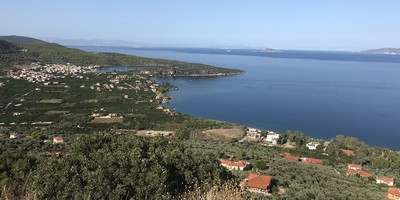
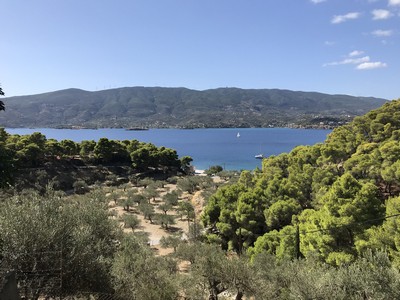
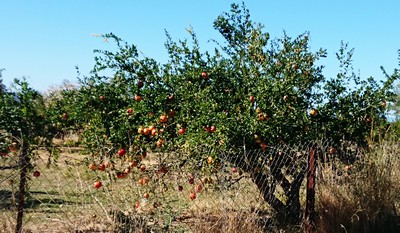
In this dry Mediterranean land olive groves and vineyards cover the hills, while orange, fig, quince and pomegranate orchards lie in the fertile plains. Each tiny yard or garden has a lemon tree, cactus and oleander, while cascading bougainvillea, or a vine, shelters verandas from the heat. Hibiscus blooms, and groves of tall dark cypresses stand guard in the cemeteries, contrasting vividly against the white limestone hills. Beehives nestle in the orchards, and honey flavoured by orange blossom, heather, and pine is sold at roadside stalls.
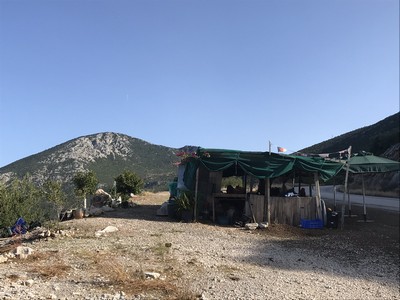
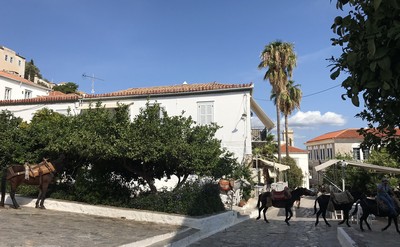
The many picturesque settlements and towns have beautiful villas and shabby apartments, their ornate wrought iron balconies rusting in the salty air.
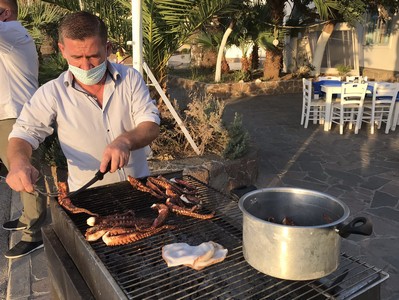
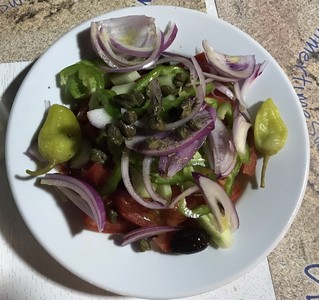
 Cats roam everywhere, searching for food and keeping the vermin at bay. Seaside tavernas serve the fruits of the Aegean, especially octopus tentacles seared over aromatic burners, and generous salads topped with goats’ cheese and olives.
In every town there is a central square with a modern Greek Orthodox church, or an old, well-preserved Byzantine church. The squares are bordered by shady tavernas and coffee shops where elderly men drink coffee and converse. After all, was it not the olive and the grape that facilitated discourse and debate here thousands of years ago? The women are at the market or the hairdresser, or cooking and cleaning and keeping the home fires in order.  Numerous roadside shrines attest to the many fatal accidents caused by the reckless driving in the countryside. Overtaking on a blind rise or corner is not uncommon; you take your life in your hands renting a car and driving there. But it is still the most liberating and exciting way to explore this country, where one stumbles on wonderful surprises around every corner – both modern and ancient.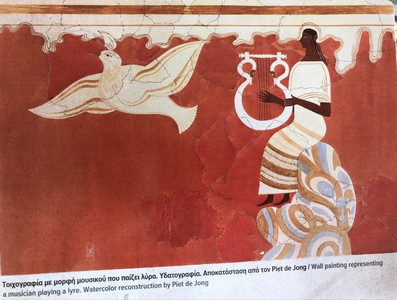
Join me on a fascinating journey through this ancient land, while I share with you some of my discoveries – well-known, quaint, and undiscovered.

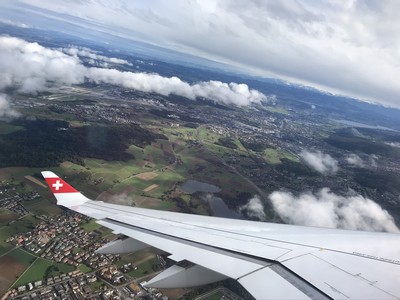
The original plan was to fly straight to Kalamata airport from Stockholm, but due to complications arising from the Covid 19 pandemic, our flight with Aegean Airlines was cancelled. Instead we flew with Swissair via Zurich to Athens, taking the opportunity to stock up on “traveler fuel” – good Swiis chocolate – on the way. I always enjoy flying into Zurich, watching the majestic ranks of snow-capped Alps as we descend through the clouds.
 After collecting our rental car, we drove for three and a half hours across the Peloponnese to our hotel near Koroni, and our friends’ villa. The Messinia province is located on the westernmost of the four Peloponnesian peninsulas. Here at the Camvillia Resort & Spa Hotel a large floodlit pool and spacious room with comfy beds awaited us. The area escaped a fierce tornedo that had recently battered the shores of mainland Greece, leaving the air ripe with the petrichor scent of rain on dry earth, and we fell asleep to the unfamiliar sounds of crickets and a pine bough tapping the eaves.

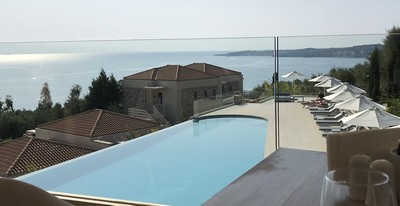
We awoke each morning to birdsong and cheery Greek greetings outside in the garden. Covid restrictions necessitated a masked waitron serving our chosen breakfast items from behind a screened buffet, which we ate on a large balcony overlooking the Messenian Gulf. Strong coffee and freshly squeezed orange juice were also available, and which we enjoyed wherever we stopped on our peregrinations, along with delicious fresh-baked Greek biscuits in a myriad different shapes and flavours.
The hotel provides a shuttle service to the small beach below – one of the few white sandy beaches that we encountered in the Peloponnese. The rest were brown and stony. 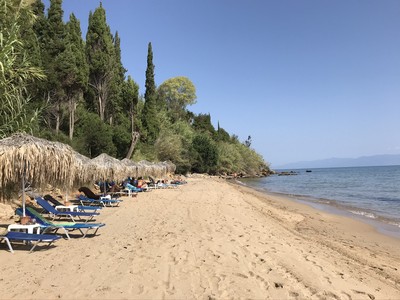 Our first exploration with our Swedish friends was to Nestor’s Palace, via the once key Venetian port of Methóni. Here we enjoyed frappés and orange juice overlooking the crumbling ruin of one of the many Venetian castles that dot the Greek coastline. From here they once controlled the trade routes in the area, and fended off the Ottomans.

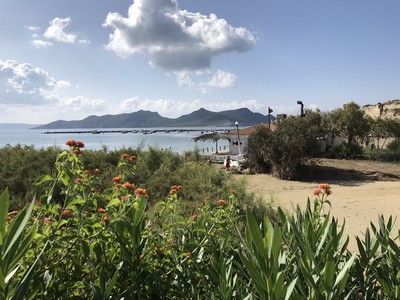 Built during the 13th century, Methóni Castle is a mixture of Venetian (a church), Ottoman (two hamams and minaret bases) and even French military architecture. Surrounded by sea on three sides, the land side of the fortress was protected by a moat.
Nestor’s Palace was the 13th century BC compound of one of the powerful Bronze Age (1680-1200 BC) Mycenaean Kings, which was rediscovered in 1939. Excavations began soon after, and continued after the WW II in 1952 under the direction of Carl Blegen.  As we marveled at information boards displaying reconstructions of this once brightly-painted, two-storey complex around a central hall, an archaeologist was at work, carefully numbering pieces of stone.


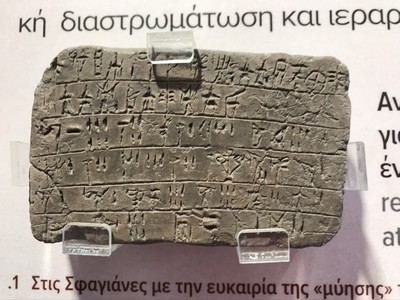
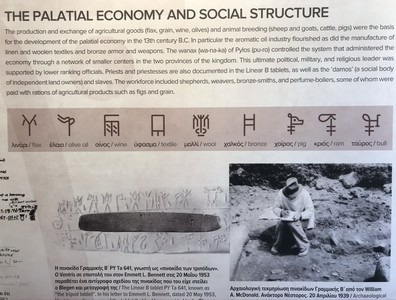
Over a thousand tablets were found here, bearing the Linear B script – a syllabic form of writing used by the Mycenaean Greeks. A tiny museum nearby displays a few objects found here, including a copy of one of these tablets.
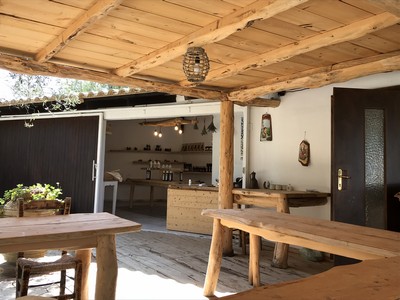
There are numerous places for wine- and olive-tasting in the Peloponnese, and we stopped at Messenian Story to taste and to different green and black olive blends. Olive oil by-products abound in these climes, from scented soaps to face and body lotions, bath oils and hair care products.
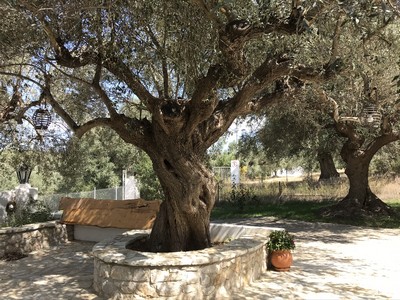
Pylos town (originally Avarino, or Navarino) overlooks the vast Navarino Bay, the site in 1827 of the famous Battle of Navarino, in which the allied French, Russian and English fleets vanquished Ottoman Ibrahim Pasha’s fleet, and which decided the Greek War of Independence. One of the beaches, Voïdokoiliá lagoon, is where Telemachus, Odysseus’s son, disembarked, in search of news of his father from King Nestor.
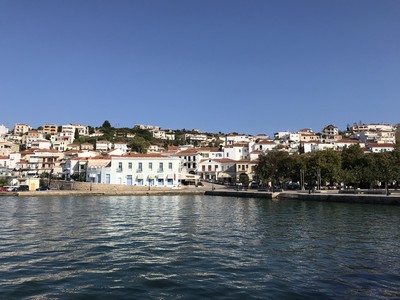
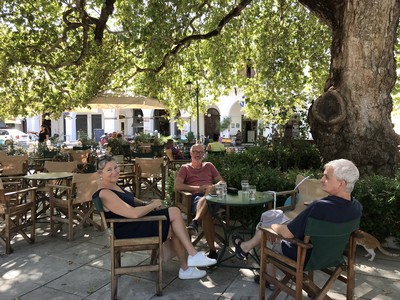
Here in a large square overlooking the bay and marina, and shaded by immense old plane trees, we had our lunch: Greek salad and rich diplas – deep-fried pancakes rolled up with cinnamon and walnuts and dripping with honey.  Koróni, one of the “eyes of Venice”, is another seaside town overlooked by a Venetian castle (begun in 1206) which surveyed the shipping lanes between the Adriatic and Crete. The castle now houses a convent.
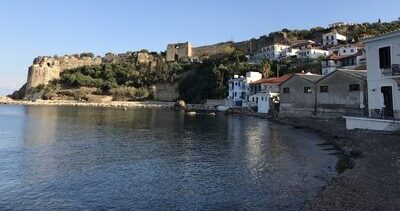
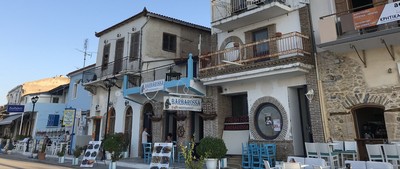
Little has changed here since the town’s foundation in 1830, and many of the houses still have elaborate wrought-iron balconies, slatted shutters, and tiled roofs with the curious “beak” at each corner – apparently to retain good fortune – or edged with little terracotta “suns”, typical of the houses in this region.

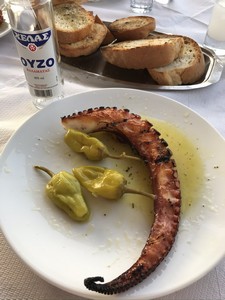
The small waterfront showed evidence of a pre-Corona liveliness, but was quiet and subdued that late summer evening. Here we savoured our delicious grilled octopus tentacles and fish, and vegetables stuffed with rice, tomatoes, peppers and spices, watching a fantastic sunset over the Messinian Gulf and toasting our friendship and good fortune with white wine and Ouzo. 
To the northwest of Koroni lies Ancient Olympia, home of the Olympic Games during Classical times – 776 BC until 393 AD, which was when Emperor Theodosius I abolished the Games. Here the Dorians worshipped Zeus, whose abode was thought to be upon Mount Olympos, and where elaborate temples and secular buildings were erected. These were mostly destroyed by Theodosius in the 4th century, and further damaged by an earthquake in the 6th century, so little remains of the once-splendid complex.
Mystrás and Sparti (Sparta) lie to the north of the second Peloponnesian peninsular, which we had insufficient time to visit. Sparta and Corinth became powerful city states during the long Peloponnesian War (431 – 404 BC) during which Athens and Sparta vied for supremacy, the latter emerging victorious. Little remains of Sparta’s former glory, the masonry of much of its acropolis, and the Roman theatre, having been pilfered over the years. This is the case with most ruins of the Ancient World, leaving confusing layers and little evidence with which archaeologists can rebuild an accurate picture.
The Byzantine Empire controlled the Peloponnese until 1460, when Mystrás, which had been founded by the Franks in 1249 and which was the last Byzantine outpost, fell to the Ottomans. The ruins of this once thriving Byzantine cultural centre signify its peak during the 15th century, a time when scholars and artists from Italy and Constantinople came here. Their influence can be seen in the cosmopolitan style of the churches, which are reminiscent of those in Renaissance Italy.
The Ottomans and the Venetians fought over this ancient land for centuries, until Venice finally succumbed in 1715. The Turks also built fortifications along the coastline, but Greek resistance continued, reaching a dénouement during the War of Independence (1821-27.) The Greeks finally emerged victorious, and made Náfplio the capital of the new Greek Republic.
Our drive across to the easternmost peninsular and the small town of Galatás, where we rented a flat for week, took us through high mountain passes and spectacular scenery.
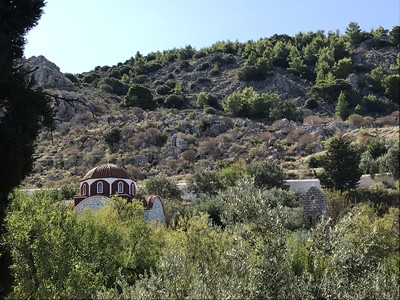

Here there are forests of pine and chestnut, rugged caves, and signs warning of snow, and sidding on icy roads. This landscape is in sharp contrast to the dry hills and fertile plains lower down. In the mountain villages, most centred with an Orthodox church, roadside stalls sell honey and jams, while lone tavernas stand of a cliff edge, commanding sweeping views over the surrounding mountains.
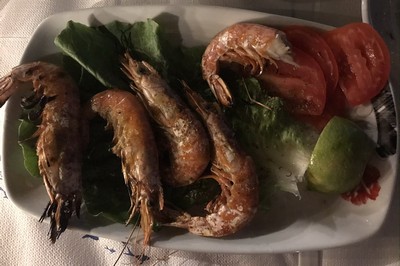
Galatás is unremarkable, but has a good, relatively new supermarket on the outskirts, where we bought our supplies. The small brown stony beach is also unremarkable, but has a taverna called Galley Taverna and Beach Bar where we enjoyed an excellent meal on our first night: grilled prawns and flat bread with hummus. Especially delicious is their deep-fried fennel pie.

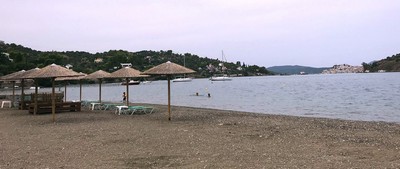
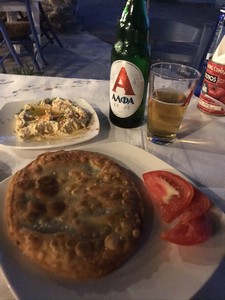
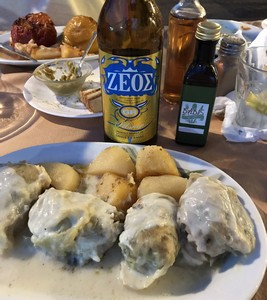
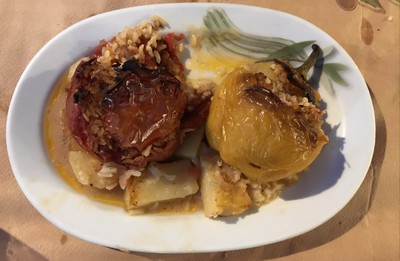
There were few customers, apart from some local regulars, but the (Corona-time) takeaway service was evidently enjoying brisk trade. The view over the Saronic Gulf includes a tiny island topped with a castle ruin, which was also visible from the shaded veranda of our lodgings. 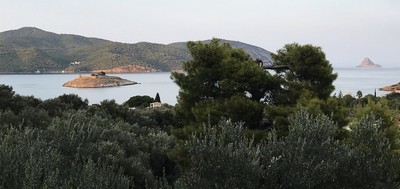 Babis is also quite a good taverna, right on the Galatás waterfront near the ferry port, where we enjoyed our last meal out: stuffed cabbage leaves and peppers respectively. A nice touch was the complimentary dessert – creamy Greek yoghurt drizzled with syrupy grape preserve.

The main attraction of Galatás is the double-island of Póros opposite, reached across a narrow strait by a half-hourly ferry. 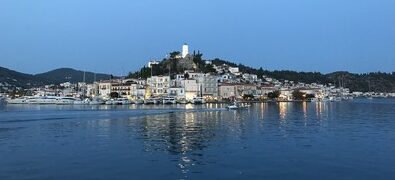
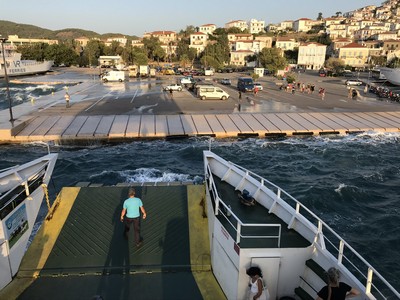
This we took, with other pedestrians, cars and trucks, across to the island for several evening meals. The little port town which faces the mainland is most attractive. There is a lively tourist trade along the waterfront, which is fringed with tavernas, jewelry and souvenir stores, and bakeries. Tiers of 19th century houses ascend the central hill topped with a beautiful bell tower. The harbour shelters numerous large expensive yachts and boats, surely the envy of many a local fisherman.
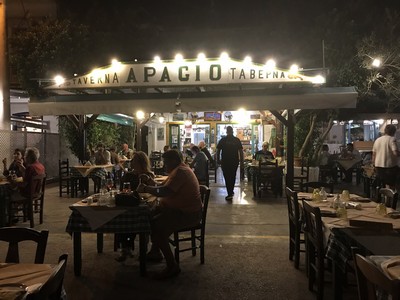
We dined on grilled fish and local vegetables, followed by an ice-cream, succulent baklava, or other baked goods found in tiny stores along the way back to the ferry port. Apagia was our favourite taverna, another family-run affair with friendly staff and excellent food. The maître di’ was one of the sons, who had worked at the Saluhall (food hall) in central Stockholm.


One day we took the car across on the ferry to explore the larger Poros island, Kalávria. Here we found the picturesque Moni Zoödóchou Pigis Monastery, which was built in 1726-32 around the island’s only spring.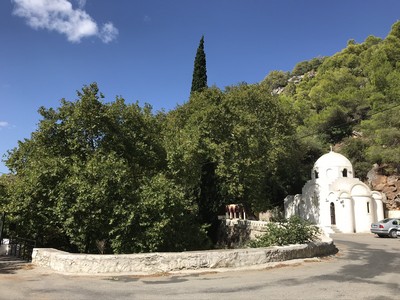
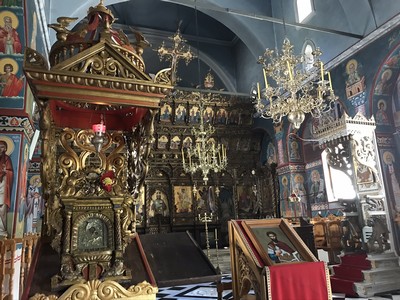
A platter of Turkish delight awaited guests in the vestibule, and black-robed monks bustled about their daily business. A beautiful chapel occupies the centre of the complex, ornate with icons of the Madonna and other saints, brass chandeliers, pulpit and a decorative altar screen. Here in this quiet, incense-scented space visitors can pray and reflect and light a candle for their loved ones.
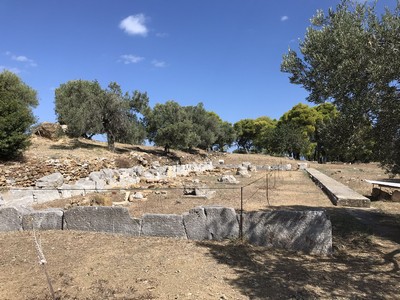
On a central hilltop stand the ruins of the 6th century BC Temple of Poseidon, of which much of the masonry has been removed over the years. It was here that the orator Demosthenes poisoned himself in 323 BC, rather than surrender to the Macedonians. Nothing stirred in this hot abandoned place, save the whispering of long ago spirits in the pine and olive trees.
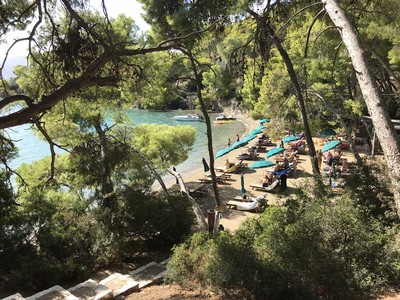
Lunch was a picnic on the beach at “The Love Bay”, a lovely little pine-shaded beach (€9 per wooden chaise) where we also enjoyed a swim in the warm Aegean Sea.
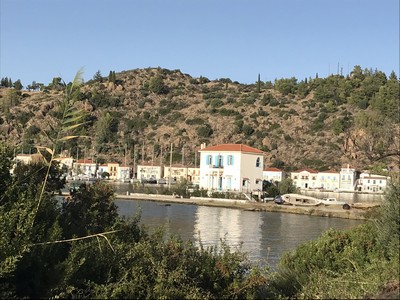
Galatás provided an ideal base from which to explore the two principle sights in the north-western Peloponnese: Mycenae and Epidaurus.
The Mycenaean civilization dominated the eastern Mediterranean from 1700 to 1100 BC, and Mycenae, discovered by the German archaeologist Heinrich Schliemann in 1874, is one of the finest examples of sophisticated citadel architecture in Greece. Here, according to Homer, Agamemnon held powerful court. It was he who raised a fleet to rescue his brother Menelaus’s wife Helen, whom the Trojan Paris had stolen away. This gave rise to the semi-legendary Trojan Wars, and feats of such warrior heroes as Achilles, Theseus, Hercules (Heracles) and the huntress Atlanta (The Iliad), and the adventures of the hero Odysseus (Ulysses) as he spent the next ten years adventuring his way back to his island kingdom Ithaca (The Odyssey).
The Mycenaean Greeks introduced several innovations in engineering, architecture and military structure, while trade throughout the Mediterranean was fuelled their economy. They invented the Linear B syllabic script, and their religion already included several deities found in the Olympic pantheon.
This Bronze Age civilization was dominated by a warrior elite society. It consisted of a network of city-states that developed rigid hierarchical, political, social and economic systems. Apart from Mycenae – the principal citadel – other Mycenaean citadels in the Peloponnese were Tiryns, Pylos (Navarino) and Midea, while Orchomenos, Thebes and Athens were those on mainland Greece, and Iolcos in Thessaly. Only the ruling class inhabited the hilltop citadels; artisans, merchants and farmers lived outside the walls.


These unbreachable walls have been described as “Cyclopean”; they are so massive (14 m wide) that it was believed that they had been built by giants.
The principal sight at this citadel is the iconic Lion Gate (c 1250 BC), which is regarded as the first example of a post-and-lintel doorway in Western architecture. In 1876 Grave Circle A was found to contain 19 bodies and gold funerary objects, including five masks, which are now on display in the National Archaeological Museum of Athens. Schliemann thought that he had found the mask of King Agamemnon himself, but modern archaeological research suggests that this mask dates to about 1600 BC, thus predating the period of the legendary Trojan War by about four centuries. 
There is also the Northeast Gate, the Royal Palace, a smaller palace, and many other houses, shaft graves, and tholos tombs – including that of Clytemnestra, Agamemnon’s wife. Our guide, found loitering at the ticket booth in the hopes of eager tourists such as ourselves, took us around for two hours, regaling us with history and legend intermingled. I was glad to have an expert make some sense of these piles of stones, without whose knowledge we would not have known at what we were looking.
Many theories have been put forward as to the reasons for the collapse of the Mycenaean Age, along with the waning of the Bronze Age and commencement of the Iron Age: the arrival of the Dorians, or activities associated with the “Sea Peoples”, natural disasters, and climatic change.
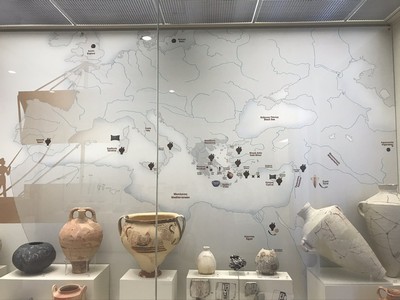

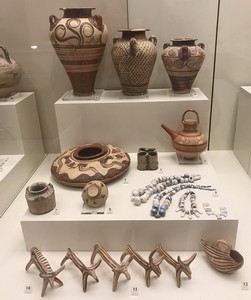
An excellent small museum nearby displays finds from the site, including jewelry, pottery, utensils, weapons and ornaments. It is a treasure trove revealing a remarkably sophisticated way of life that endured a long time ago.

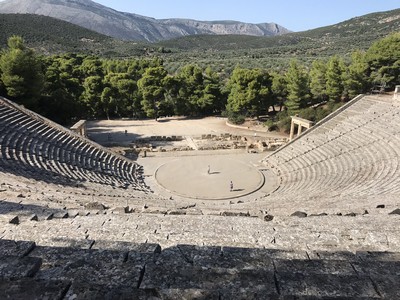
Epidaurus (Epidavros) is equally fascinating, especially the magnificent amphitheatre, which remains one of the best-preserved ancient sites in Greece. Designed by Polycleitus in the 4th century BC, the theatre is well-known for its excellent acoustics. Theatrical and musical performances have resumed taking place here in our own era, including by such luminaries as Maria Callas. The circular orchestra (stage) is the only one to have survived from antiquity, although the altar that once stood in the middle is long gone. The remains of the skene (main reception hall) stand behind the orchestra facing the auditorium, as does the proskenion, which was used by performers as an extension of the stage.

Nearby stand the remains of the Asklepieion Sanctuary.
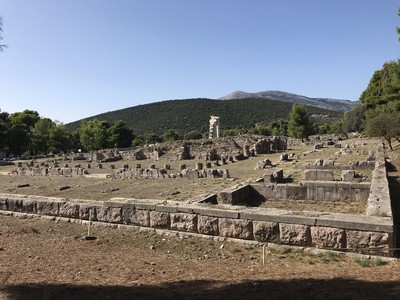
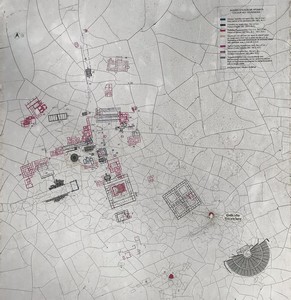
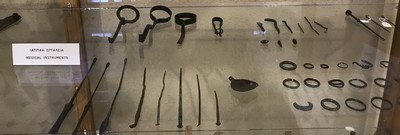
Asclepius was the god of medicine and healing, and the sanctuary was a sophisticated complex which included a propylaea (gateway), tholos (circular building of uncertain function), and an enkoimitrion (dormitory) where patients slept and awaited a diagnostic dream, or a visit from harmless serpents. Therapeutic mineral springs, one of which still provides visitors with water near the little museum, were also used for curative purposes. The museum houses sculpture remnants, ancient medical instruments, and other finds from the site. A pavement, some of which still survives today, led from the Sacred Way to the coastal town of ancient Epidavros. 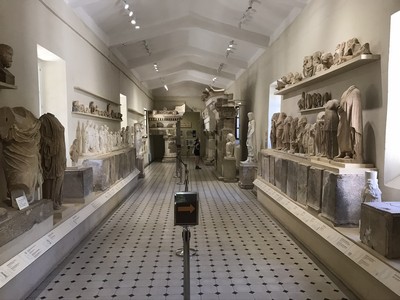
The sanctuary was active from the 6th century BC until at least the 2nd century AD. As a proponent of music therapy, I was fascinated by the concept of drama therapy – role play and psycho-dramas, which were used as part of the healing process in this sophisticated theatre-sanctuary complex.
Greek drama developed from ritual role-play and group dancing at festivals to Dionysus. There were singing and dancing choruses, and individual actors who declaimed, their masks making their character roles visible from a distance. The earliest Greek plays were tragedies, with comedy only becoming part of dramatic festivals in Athens in the 1st century BC. And herein lay the ingredients – and roots – of opera, today the most popular Western musical theatre form. Greek theatre included choruses (which commented of the action), solo songs (which evolved into the aria), acting, costumes, declaiming (recitative) and dancing. Opera evolved from Greek theatre to the miracle and mystery plays of the early medieval Christian church, to the late Renaissance experiments in Florence, the courtly 17th century Baroque extravaganzas, and the operatic stage of the 18th and 19th centuries, to the rock and modern opera of today.
One day we took a short drive to the tiny town of Méthana, situated on its own little volcanic peninsula on the coast north of Galatás. (Méthana in Greek means volcano.) The pungent sulphurous odour as we entered the town informed us of the presence of the hot mineral springs that bubble from the seabed. There are 25 sulphur springs altogether, which together form the lake of Vromolimnos. Although the water isn’t particularly warm, it is a strange milky-turquoise colour, and certainly malodorous. Several locals were enjoying its therapeutic qualities, and, after changing in a small brick outhouse, I soon joined them. (A soapy shower is necessary afterwards, to eliminate the stench that clings to one’s skin.) 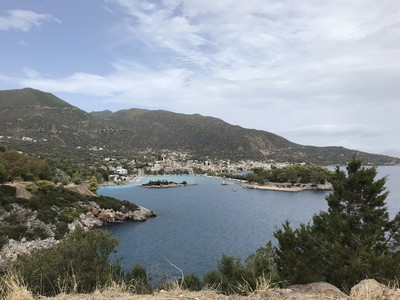 The last volcanic eruption occurred near present-day Kaimeni Chora/Hora (a pretty little village on the other side of the peninsula) in 230 BC, and a submarine volcano erupted in 1700. Famous writers such as Ovid (43 BC – 17/18 AD) and Pausanias (a 2nd century AD Greek geographer and writer) wrote about the volcanic eruptions here. More eruptions can be expected in this area in the future.
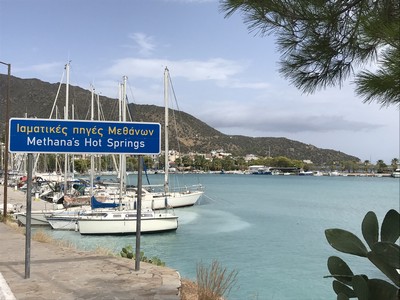
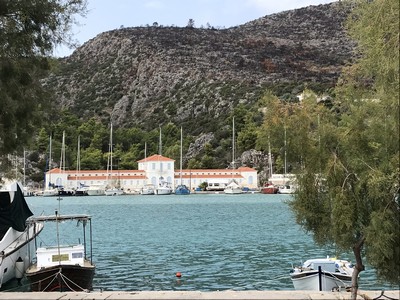
A large spa complex, built in 1930 and famous for its thermal baths, bears testimony to Méthana’s once thriving existence as a spa resort town. Apart from a few tavernas on the waterfront, there isn’t much other visible tourism here.
Our last three nights were spent on the island of Hydra (Ydra), reached by ferry from the port of Ermióni, where we left our car.
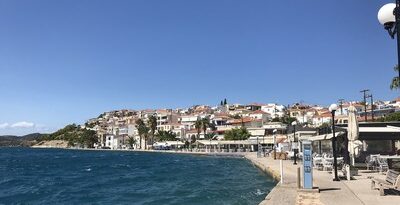
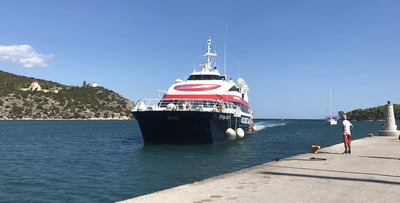
We stayed in a delightful guesthouse called Nereids located at the back of the picturesque harbour town. Our host Kostas greeted us warmly, and carried our case on his shoulder up several levels to our rustic room. Here a small terrace, shared with three other rooms, has a lovely view over the town, sea, and distant mainland.  This was where we all ate our self-catered breakfast (each room has a bar frig and kettle) and engaged in travel conversation.
This location meant that we were near several small-holdings, one of which kept chickens and roosters in a fenced-off cave. These vociferous birds also made their presence known pre-dawn, and the tinkling of the goats’ bells could be heard filtering down from the hills. Opposite the hotel is a school, past which I strolled one morning, eavesdropping on a maths class in which I was decidedly glad not to be participating. 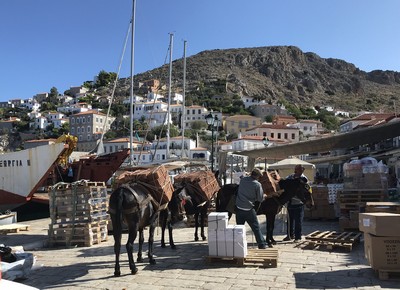 Donkeys are the only mode of transport on the island, and these beasts of burden can be seen at the port, being laden with building materials and goods.
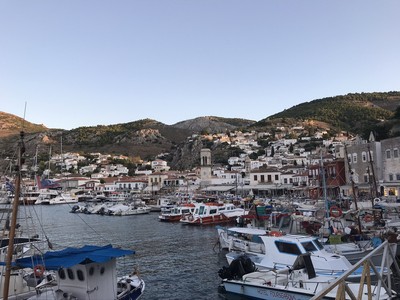
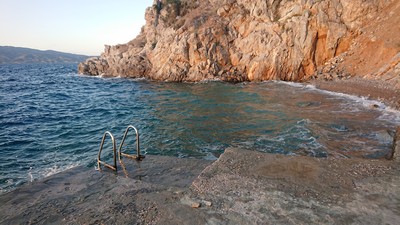
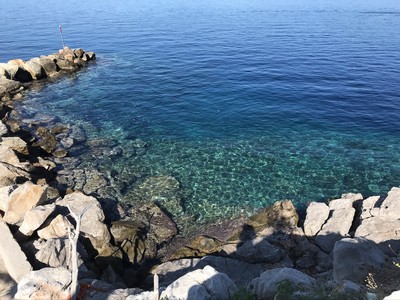
Hydra has a wonderful, peaceful atmosphere, the only other sounds the chiming of church bells and the port clock tower, and the wind and sparrows in the eucalyptus trees. Now and then the approaching ferries can be heard sounding their horns. Around the corner from the tiny harbour, swimming is possible from the rocks, where metal ladders enable visitors to step into the cool clear water.
There are several hikes across this long narrow island, to various inaccessible beaches which can also sometimes be reached by water taxis. Apart from the cypresses in the monastery cemetery at the top of the hill, the pines in the town, and a scattering of olives and heather, there is little greenery in this barren rocky place.
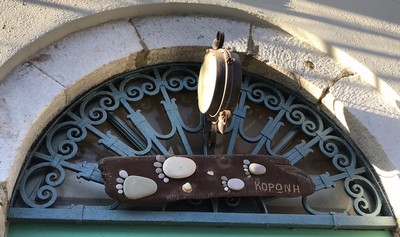
Kamíni has been the island’s main fishing port since the 16th century, which is when Orthodox Albanians first settled here. Much of Hydra town was built during a prosperous period in the late 18th and early 19th centuries, boosted by blockade-running during the Napoleonic wars. After the WW II, more tourists started coming here, many of whom restored the old houses and transformed the island into one of the most exclusive resorts in Greece. Wandering through the town yields many unexpected delights: quaint houses overlooking narrow winding cobbled streets, each with blue-painted shutters, profuse cerise bougainvillea, and an ornate door with a small lady’s fist brass knocker.


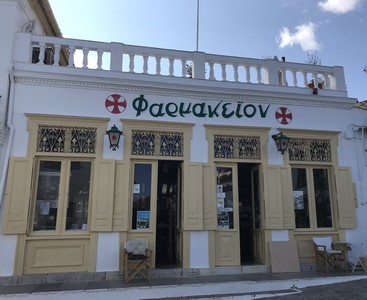
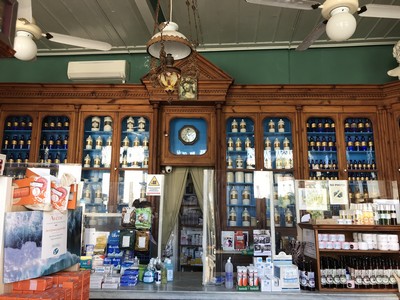
One quaint delight is the Rafalias Pharmacy, punted as “the most beautiful pharmacy in the world”, and which is over 400 years old. Here, apart from the usual modern pharmaceutical items, there are also the lovely olive oil-based preparations and cosmetics.
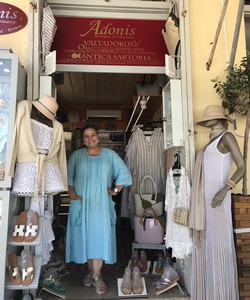
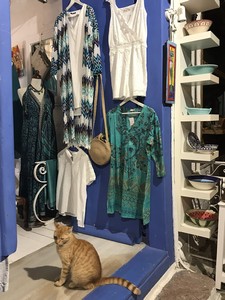
All along the waterfront there are expensive boutiques (including Adonis, where Katarina sells exquisite hand-made Greek sandals), jewelers, souvenir and gift shops.

The dozens of empty tables at the port-side tavernas were indicative of the usually crowded scenario here during peak season, but were very much reduced due to the current pandemic.
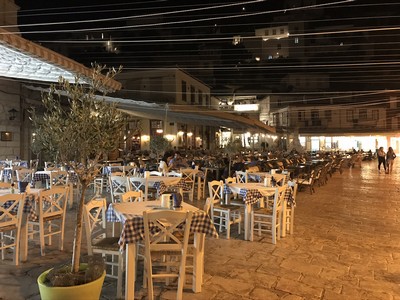
Most of the tourists we encountered were Greek; a little German, and some Slavic and British English dialects could also be heard.
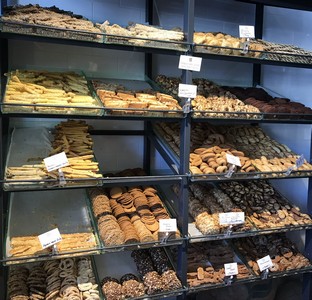
We also enjoyed the three bakeries, especially Drougas Bakery, where we could choose from a vast array of freshly-baked biscuits to fill a paper bag and enjoy on the quay and the ferries.

Just behind the centre of the marble-paved waterfront is the Panagia Church, built from 1760-70 using masonry from the Temple of Poseidon on Poros. No wonder there is little to be seen of the Temple today!
One evening we enjoyed a special meal at Techné Restaurant, which had been recommended by our friends. As the name suggests, we were treated to an excellent meal created with much “craftsmanship” (“skill”), overlooking the Aegean Sea. Tables are laid on a double terrace, aglow at night with candles. It was a very special evening in a romantic setting. 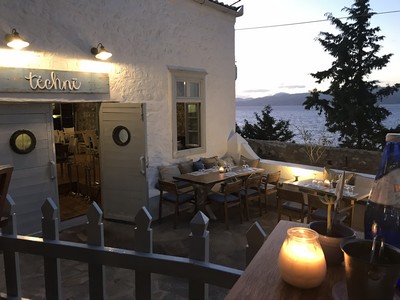
On our middle day we took the ferry to the green island of Spétses, the ancient name of which derives from the Greek word meaning “piney”. We were immediately put off by the many noisy motorbikes that whizz crazily up and down the narrow streets in this historic place.
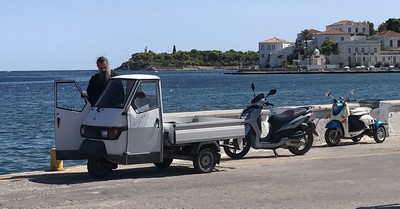
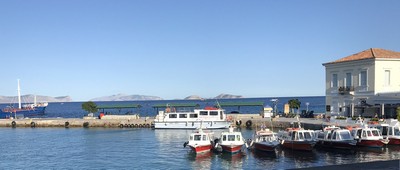
Spétses was occupied by the Venetians in 1220, the Ottomans in 1460, and, like Hydra, by Albanians during the 16th century.
On the waterfront stands the statue of Spétses heroine Laskarína Bouboulina, the admiral who confronted the Turks from her flagship Agamemnon, and allegedly seduced men at gunpoint! She was shot in 1825 by the father of a girl with whom her son had eloped. 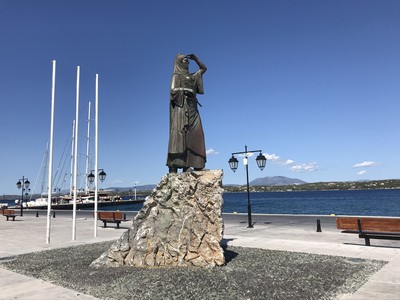 Before meeting up with our friends once more for an evening drink, we explored the little waterfront town, with its narrow pedestrian shopping street and fishing boat harbour.

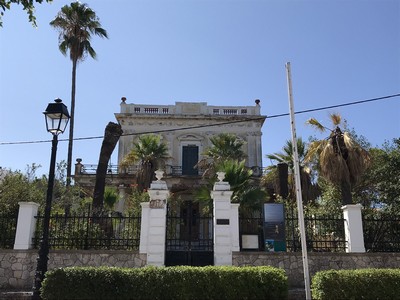
I fell in love with a gracious old villa that was boarded up and falling into disrepair. Clearly no-one can afford to take it in hand, and lavish upon it the care and attention it obviously once enjoyed.
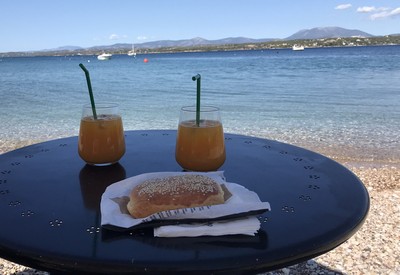
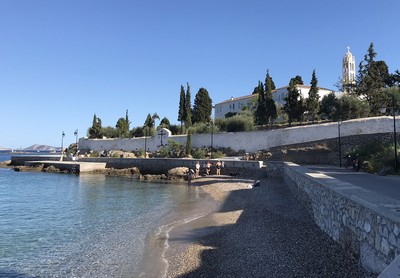
After a leisurely lunch of a cheese pie from Drougas and freshly-squeezed orange juice on one small beach, where I collected dozens of tiny brightly coloured pebbles, we walked along the seafront to another little stony beach. Here, abandoning our search for a church due to the heat and afternoon torpor, we stopped for a swim in the clear turquoise sea.
Our final day was spent making our way back to Ermioni on the ferry to retrieve our car, and an unremarkable hotel near Athens airport in preparation for our early flight back to Stockholm the following morning. The winding coastal route took us back past Epidavros seaside town and across the Corinth Canal.
Old Corinth was one of the major trading cities in ancient times, made prosperous by its location on the narrow isthmus between the Saronic and Corinthian Gulfs. Before the 6 km, 23 m-wide Corinth Canal was built (1882-93), the ships were dragged across this narrow space, in order to avoid the long journey and stormy conditions around the Peloponnese peninsulas. It is no longer wide enough for the massive tankers and container ships of today, but small freighters and yachts can be seen from the road bridge, making their way through.
The Romans sacked Ancient Corinth in 146 BC when they conquered Greece, making the country a province of the Roman Empire. A century later they rebuilt and colonized it. The city acquired a reputation for intrigue and immoral behaviour, and St. Paul, who founded a church there in around 50 AD, wrote letters to the Corinthians addressing these issues and several others, which can be found in the New Testament.
A significant naval battle took place – the Battle of Lepanto – in the Gulf of Patras, which lies west of the Gulf of Corinth, between the northern coast of the Peloponnese and mainland Greece. Here, in 1751, a combined fleet of Christian states assembled by Pope Pius V routed the Ottoman fleet. This victory of the Holy League marked a turning point in Ottoman expansion into the Mediterranean, although the Ottoman wars in Europe would continue for another century.

It was with sadness that we flew away from this fascinating land, with its serenely hushed monasteries, ancient ruins and medieval fortresses. We will remember the delicious cuisine, flavoured with fresh herbs and olive oil, and enjoyed with local wines, the stories of ancient heroes and their exploits, and swimming in the mildly cool Aegean.
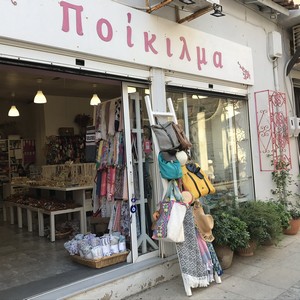
Memorable too are the little-visited villages, with their shady squares where church bells chime and the coffee strong, and the modest stores where beautiful handcrafts are sold. And the wild mountain passes, turquoise bays, and stony hills where goat bells tinkle and mythical deities whisper in the olive groves, and the sun sets gloriously over the ancient seas.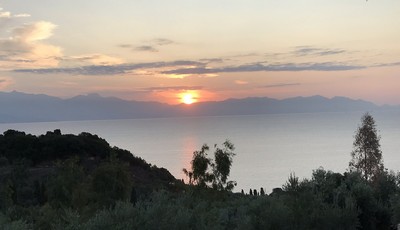 Efcharistó. Tha epistrépsoume. We will return.