
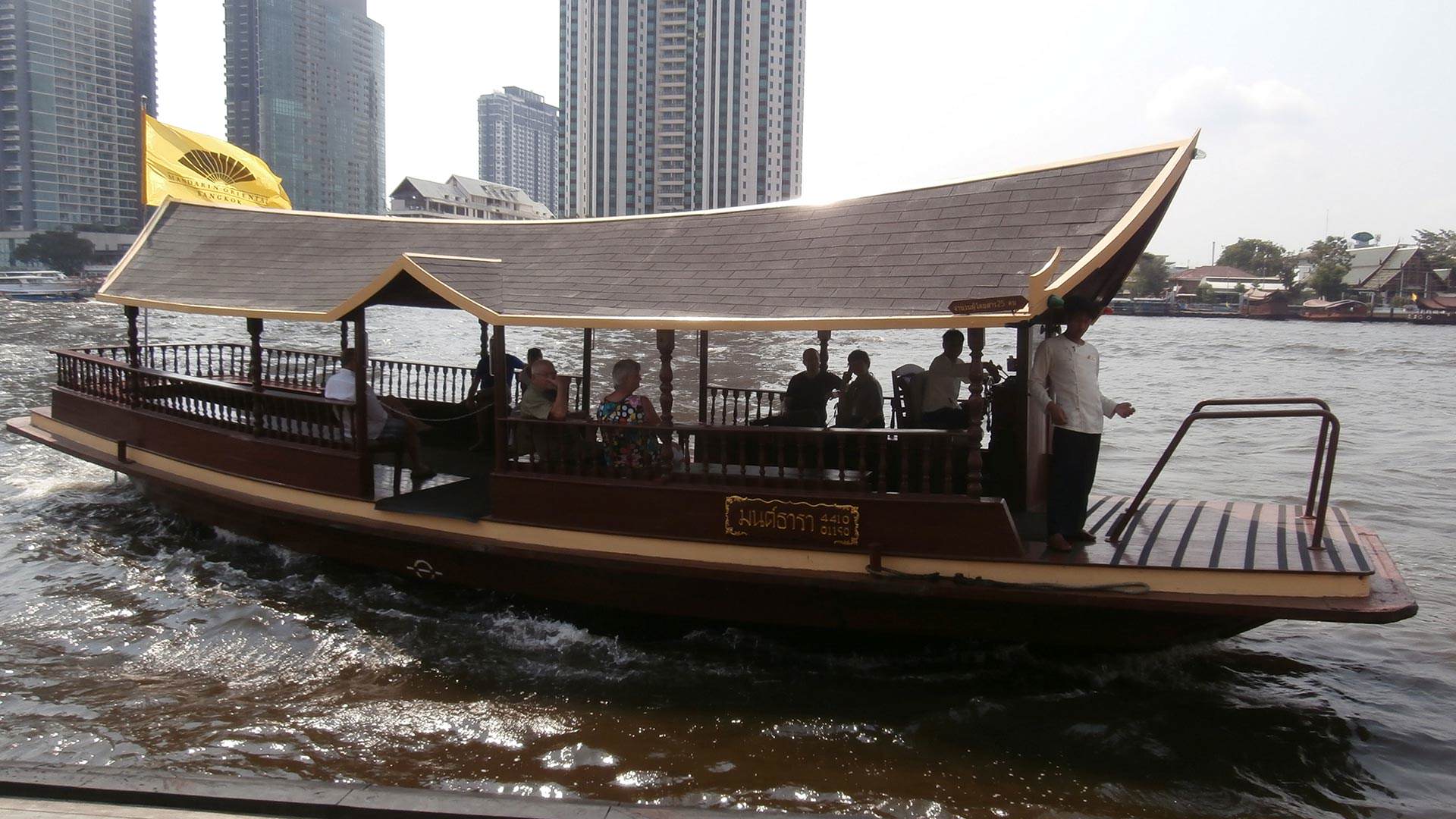

A WEEK IN BANGKOKCITY OF TOWERS AND TEMPLES, MALLS AND MARKETSFor first time travellers to BangkokElizabeth Handley’s travel piece on this fascinating country is required reading!– PART TWO – |
Royal harems, shaven-headed Buddhist monks, hand-fed white elephants, twins who shared the same body, a floating city that mixed architectural grandeur with diabolical poverty…these were the stories that captured the imagination of the outside world and made personal accounts of Old Bangkok by writers such as Anna Leonowens (of The King and I) international best-sellers. (Old Bangkok by Chris Burslem.)
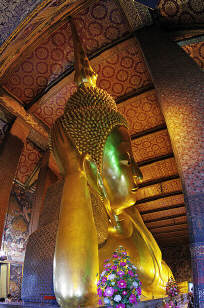
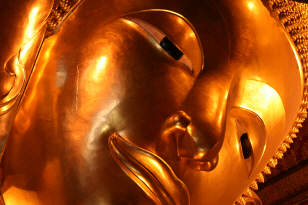
This is the oldest Wat in Bangkok, and traditionally a centre for public education and traditional medicine. It includes the famous Institute of Massage, and on the walls of the Medicine Pavilion carved stone plaques indicate the massage points on the body. A miniature mountain, one of several in the complex, display statues of naked hermits in the different positions for healing massage. Since 1960 Wat Pho has run the most respected massage school in the city. This ancient form of healing, called Nuat paen boran (traditional Thai massage) dates from the time of Buddah, and is related to Chinese acupuncture and Indian yoga.
My experience of traditional Thai massage, in the spa at our hotel, came as something of a surprise: pressure on certain points by the masseuse through the soft cotton pyjamas which I was offered to wear, and the kneading and contorting of my limbs into uncomfortable but presumably beneficial positions. I was struck by the old-world charm of the young ladies in the spa, kneeling before the guests with offers of a strange juice made from flowers, and fruit, and making polite small-talk while we waited for our appointments. (One of these intrepid young ladies is due to go and study cooking in the USA.)
The main bot at Wat Pho houses a bronze image of a meditating Buddha which was salvaged from Ayuttaya by Rama I’s brother. Farang (Thai meaning “foreign”) – huge stone figures with big noses, beards and top hats – guard the inner gates of the compound. One theory is that they are caricatures of Europeans, another is that they were the ballast used by crafty Chinese traders to balance their ships, but which they fooled the Thais into believing was merchandise.
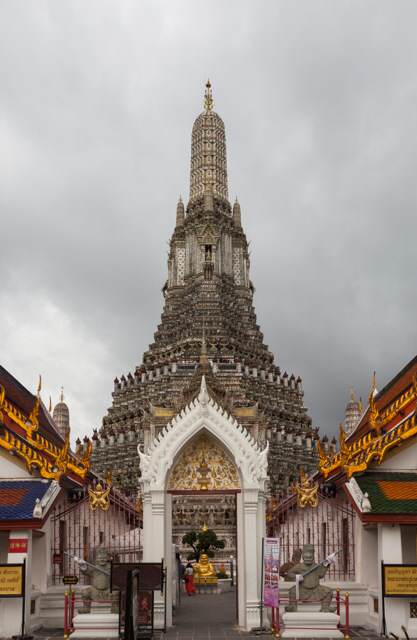
Templo Wat Arun Bangkok Tailandia
Our last Wat, and point of interest for the day, was Wat Arun (Temple of Dawn) – named after Aruna, the god of dawn – and is reached by a ferry on the other side of the river. Legend has it that King Taksin (r. 1779-82) arrived here at sunrise in 1767, from the sacked ancient capital of Ayutthaya further down the river.
This temple was enlarged and added to during successive reigns, and is richly decorated with gods and demons made from broken pieces of porcelain that originally formed the ballast of Chinese merchant ships. The 79-meter-high prang (a round, finger-like tower) is reached by a series of steep steps, and is regarded by Buddhists as a symbol of the path to Enlightenment. Further ornamentation of this structure are the minutely detailed mondops (altars), each containing an image of the Buddha at various important stages during his life: birth, meditation, the preaching of his first sermon, and Nirvana – the achievement of perfect peace.
Apart from this spiritual feast, the body needs sustenance, and there is no shortage of exciting eateries in Bangkok, varying considerably in flavour, variety, quality and cost.
The more upmarket restaurants offer a wide range of cosmopolitan cuisines including French, Italian, Japanese and Mexican. But Thai food is what I had come for, and this was what we enjoyed throughout my stay.
Thai cuisine is distinguished by its aromatic and spicy qualities. Chili peppers were actually introduced to Thailand from the New World in the 16th century by European traders, and Chinese and Indian influences can be seen in the curries and stir-fries. Thai cuisine aims to strike a balance between the four principal flavours of sweet, sour, salty and hot. Fortunately, most menus illustrate the degree of “heat” with little chili images in the margin, ranging from one chili (mild) to a scorching, eye-watering three chilies.
Cabbages and Condoms, a delightful restaurant with an outdoor courtyard complete with miniature waterfall and wishing well, offers many delicious Thai dishes. These are garnished with the traditional flavours of garlic, lemongrass, green peppers, ginger, kaffir lime leaves, turmeric, galangal, Thai basil and chili. The quirky name of this establishment, with its charming setting beneath strings of fairy lights and pretty lanterns hanging from overhead “jungle” vines, arises from an initiative to increase awareness of safe sex (HIV and AIDS) and family planning. The courtyard area is decorated with large statues and hanging lamps made entirely from brightly-coloured condoms – a novel way indeed, to promote healthy sexual relations!
A pretty girl dressed in a pink and white floral silk dress, with strings of pearls, and orchids in her hair, played a khim (a dulcimer – a stringed, zither-like instrument, struck with two slender sticks.) The softly twangy timbres of the khim mingled with the gentle trickle of water and softly chinking glassware. A meal there is a magical and unforgettable experience. But beware the Tom Yam Kung – unless you are inured to very hot flavours!
Less upmarket, but no less popular is Suda, a family-run eatery in Soi (lane) 14 off Sukhumvit Road. Here a vast variety of traditional Thai dishes, wisely displayed in pictorial menus in both Thai and English, is served with little delay to locals and tourists alike. Examples are Tom Yam Kung (the signature sour shrimp soup), Kaeng Hang Le – a mild pork curry with ginger, peanuts and garlic, Sam Tam – shredded unripe papaya and other vegetables with lime juice, chili, fish sauce and dried shrimps, and Kaeng Leung Pla – a spicy fish soup with bamboo shoots, tamarind, chili, garlic and palm sugar. We settled for fried pork with unfamiliar greens, and mild curried chicken with cashews, served with just-tender stir-fried vegetables and steamed rice. The vegetables included strangely-shaped mushrooms and seaweed, with the usual cauliflower and broccoli florets, sliced carrots, green beans and white-green cabbage leaves.
Face Bangkok is another excellent restaurant, also off Sukhumvit Road, and part of a complex that includes a Thai massage spa, and two other dining rooms, apart from that offering Thai cuisine – Indian and Japanese fare. Diners can mix all three cuisines if they wish.
As the website attests: “We saw the whole complex as a “Caravansary” (as on the silk route) a meeting place which is secure (enclosing), welcoming, and multicultural, using antiques and artifacts from the traders and trader cultures who visited this region. We stressed diversity and multiculturalism in a sensual, friendly environment where you can meet, eat, drink and talk, face to face in a calm secure atmosphere.”
I loved the wooden buildings, ponds, and gardens bursting with vigorous tropical vegetation, as well as the delicious Thai meal.
The manager turned out to be charming young South African (with a Thai wife and child), Jeremy Leibbrandt. I’m sure if you visit his unique and atmospheric establishment you will receive as warm a welcome and guided tour of the place as we did. See https://www.facebars.com/en/bangkok/restaurant/
There are also Face restaurants in Shanghai, Beijing and Jakarta.
I also enjoyed the exotic cosmopolitan mix in Bangkok. Oriental peoples with various mellifluous dialects, to me indistinguishable from one another, of course predominate. Thai is a language with 44 consonants and 32 vowel sounds, the written form of which was developed in 1283 from a southern Indian script. Although writing is from left to right, words are not separated within sentences, and punctuation is minimal. The slightest variation in intonation and inflexion can give a word a different meaning. Our Western ears are not well attuned to such nuances, and I fear that my pronunciation of kòrp-kOOn-ká (Thank you) may have been off key.
The Thais themselves are a friendly race, always with a ready smile and a friendly comment. If I happened to share the elevator with a staff member at the hotel, I was greeted with a conversational “What did you do today?” or “What did you buy?” While the staff in hotels and stores are deferential – even obsequious – I am told that the work environment is extremely brutal. Superiors can be ferociously verbally abusive to underlings, even in front of foreign businessmen, something incomprehensible and offensive to Western visitors. Fortunately, as the wife of a travelling businessman, I am not exposed to such behaviour.
The Thai greeting is very specific: known as the wai, it consists of a slight bow, with the palms pressed together in a prayer-like gesture facing in towards the chest. The origin thereof lies in the Indic Añjali Mudra, like the Indian namasté and the Cambodian sampeah. The higher the hands are held in relation to the face and the lower the bow, the more respect or reverence the giver of the wai is showing. The wai is traditionally observed upon entering someone’s home. After the visit is over, the visitor asks for permission to leave, and repeats the salutation made upon entering. The wai is also common as a means to express gratitude, or to apologise.
Thai ladies are almost universally pretty, petite, and tastefully appareled with an Oriental chic all their own. Young women and girls favour outfits which I came to dub the “cutey-pie” style: little lacy tops and frilly mini skirts, with slender bare legs and low-heeled pumps. Pretty cheap jewelry and accessories complete the look, as does a floral backpack to which a tiny teddy bear is attached. Many Thai women are beautiful, and I can quite understand their attraction to European men. A common sight in Bangkok – especially of an evening – is a middle-aged European male with a pretty Thai “companion”. Sex tourism abounds in Thailand – and human trafficking – as the numerous warning posters attest.
Thai men are not particularly handsome, and were (to my eye) beaten hands down by the handsome Latin tourists.
Then there are the ex-pats, conspicuous by their height, manner and dress: neat businessmen in pin-striped suits, tall tattooed Teutonics, and deeply tanned aging hippies with stringy long hair, tattered shorts, “wife-bashers”, and thong sandals. The women are similarly dressed, but with long Indian-print skirts and faded cotton sling bags. There are thousands of young back-packers touring the East, speaking many European languages. I heard mainly German, and Latin and Slavic languages. Family groups seemed to be predominantly French-speaking, and I pitied all the children, flushed and exhausted by the heat, and doubtless experiencing the queasiness that I sometimes experienced, caused by the change in stomach flora, and the strange food of exotic equatorial climes.
There are many unusual and interesting sights in this quirky city – too numerous to mention, and certainly too numerous to see in one week.
Bangkok is not a beautiful city. At first glance it is chaotic, smelly and disconcerting, with a labyrinthine jumble of alleys and klongs (canals), winding beneath the Skytrain and flyovers. There is much that is extremely ugly, sad and tawdry. Beggars, apparently mostly from Cambodia, squat on the footbridges and exits to the shopping malls, using their ragged and sometimes deformed children as a source of income. At night there are the glamorously-dressed prostitutes and “lady-boys”, standing in groups and chatting animatedly in a mixture of English (for the benefit of potential passing trade) and Oriental dialects.
But it is a city full of unexpected surprises. Quite by chance I would happen upon a beautiful park, hidden behind high walls, or a courtyard with a pond and splashing fountain, or an interesting little shop, or a purse-wilting market, bursting with delicious temptations – both visual and olfactory. Once, from the Skytrain I looked down on what once must have been a colonial country club, with tennis courts and lush lawns set in beautiful exotic gardens.
Bangkok has a flavour and atmosphere all its own, at once alluring, exotic, sultry and secretive. One is aware of other unseen levels of existence, away from the public eye, and known only to the initiated. But for the visitor, there is so much to explore and see that is totally different from our own Western world.
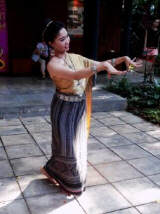
Another of the “top sights” is a guided tour of the Jim Thompson House – the Thai-styled home of the eponymous American silk entrepreneur who mysteriously disappeared in 1967 aged only 61. Thompson was, apart from Queen Sirikit, greatly responsible for the resuscitation of the Thai silk industry after the World War II. His mansion harbours an extremely valuable Asian art collection which includes ancient stone and wood-carved images of the Buddha, rare Chinese porcelain, and Cambodian and Thai artifacts. In one gallery visitors can see baskets of silkworms munching their way through mulberry leaves, and a large flat wheel-like basket divided into circular sections which contain hundreds of yellow and white cocoons. At the entrance to the museum a man sits on a low stool collecting skeins of silk from cocoons bobbing in water heated by a charcoal burner, and using a special little hand-wound machine. Beside him a beautiful young woman demonstrates Classical Thai dancing to the strains of a CD player, her hands weaving in and out in a language clearly imbued with inscrutable Oriental symbolism.
On excellent restaurant, and shop selling Jim Thompson-branded silk goods, complement this excellent tourist-friendly complex. See https://www.jimthompsonhouse.com/
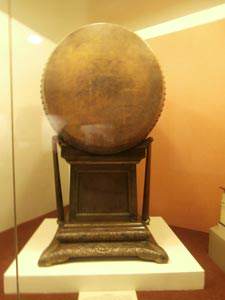
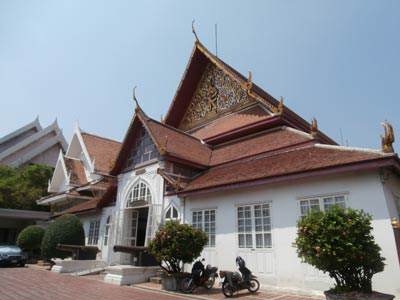
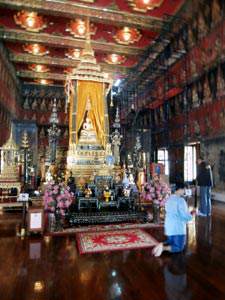
The National Museum (another “Top sight”) offers not only cool respite from the city’s oppressive heat, but is well-worth a visit for its interesting exhibits. It consists of a well-laid-out complex of buildings which include picturesque pavilions and halls, and is situated in the former Palace of Wang na (The Front), which was constructed in 1782. It provides an excellent overview of the art and history of Thailand. Contrary to the DK Eyewitness guide book, all exhibits are extremely well-labelled in both Thai and English, and I don’t believe a guided tour is necessary.
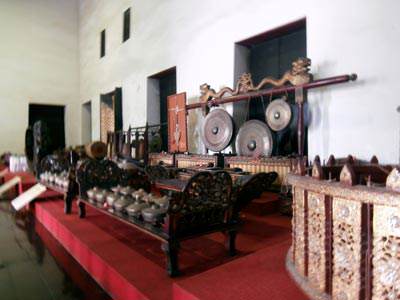
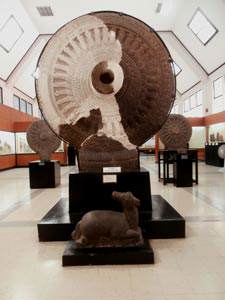
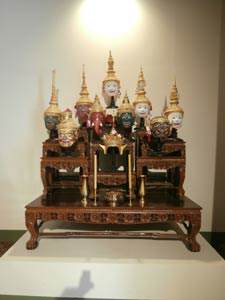
I particularly enjoyed the “Gallery of Thai History”, situated in the Siwamokkhaphiman Audience Hall, which takes visitors on a fascinating visual journey from ancient Thai communities in Neolithic times and early civilizations in the Mekong region, to the modern era. Also interesting are the rooms of theatre and dance, with display cases filled with beautiful old stick puppets, costumes, fearsome masks, and headdresses. Of course I also headed for Room 514 room, in which a wide range of Thai musical instruments and a Thai “orchestra” are on display. These included a sueng (lute), a Khim (dulcimer played with little wooden sticks), a ranet (xylophone), and a host of other xylophones in various shapes and sizes, gongs, drums, and wooden instruments.
See https://www.itdaculture.com/EN/en_thai_instruments.html
For a guided demonstration of Thai musical instruments, see YouTube:
Lonely Planet claims that the newly-opened Museum of Siam is better than the National Museum. I look forward to seeing that on my next trip.
Ohere were conflicting opinions regarding Bangkok’s China Town – some saying once you’ve seen one you’ve seen them all, whether it be in Cape Town, London or San Francisco. Kally believes that the Bangkok one has an atmosphere of its own, and should not be missed. Perhaps next time…
Bangkok is a shopper’s heaven. From shabby little street stalls to outdoor markets and massive shopping malls, this city literally has it all. Electronic goods are notoriously cheaper here than in the west, but their origins are sometimes dubious, and the software complicated, which is why I hesitated to buy any. The malls carry most of the well-known Western designer labels (same old same old), but what I found intriguing were the Asian designers of whom I had never heard. Emporium, my favourite of the larger malls, is centred around a beautiful department store also called The Emporium, in which I saw numerous examples of these expensive goods – beautiful women’s clothes made from exquisite fabrics, in designs so fresh and different from anything I have seen in the West, and all elegant and petite, clearly designed for petite Oriental ladies.
Best of all in this mall is an excellent bookshop, Kinokyniya, with books in Thai, Chinese and Japanese, but mostly in English: Here I was able to buy many interesting books about Thailand and Bangkok (see References *).
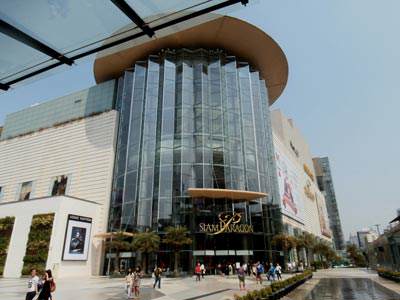
Siam Paragon is another beautiful and glitzy mall, easily reached at the Skytrain station Siam. However, for the similarities to Hyde Park or Cavendish in South Africa, I barely felt as if I were in a foreign city.
Terminal 21, on sukhumvit Road, is unique for the cluster of tiny boutiques on the third floor, known as “Tokyo Floor”. Junique is one such shoplet, where I tried unsuccessfully to better the price of a pretty chiffon evening dress displayed on the (interminable) sale; https://www.facebook.com/juniquevintage. There are also tiny shops selling delicate silk scarves (where the friendly shop assistant told me “I see you like pink!”), and gorgeous Thai lingerie.
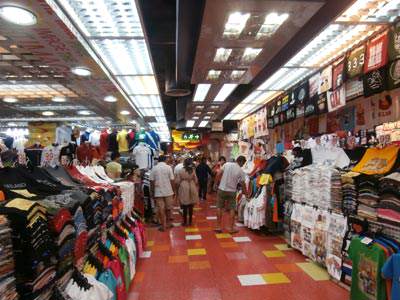 MBK is a very popular mall with tourists, especially for cheap electronic goods, jewellery and clothes. The latter can be found in numerous stalls reminiscent of the Oriental Plaza in Johannesburg, in which goods may be bargained for. Jewelry shops are numerous, and exhibit glittering arrays of gold and precious stones. And if you have been on your feet for a long time, there is a foot massage salon, with rows of divans and busy masseuses to bring relief to aching limbs. I did enjoy the relaxing music piped through all the malls I visited, definitely conducive to a pleasant afternoon’s window shopping and exploring – away from the heat and bustle.
The food courts and halls in the malls are fascinating to the Western eye. Unlike anything I have seen in Harrods, Selfridges, Macy’s or NK (Stockholm), here you can find all manner of Oriental fare and goodies, from garishly-coloured birthday cakes to exotic satays, pies and pastries, and strange-looking sweetmeats.
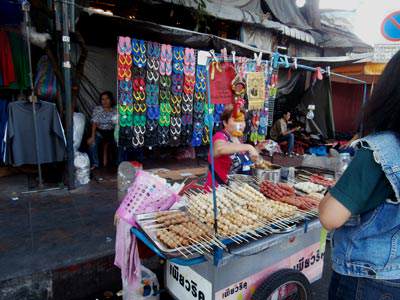
The whole-sale consumerism in the Far East is mind-boggling. At one end of the spectrum are the awe-inspiring shopping malls – great glass and chrome temples to the famous Western designer labels and expensive electronics goods. At the other end is an incredible abundance of cheap Chinese tat, sold at street stalls and in the markets, and including anything from bling phone covers to T-shirts and Thai woven sandals.
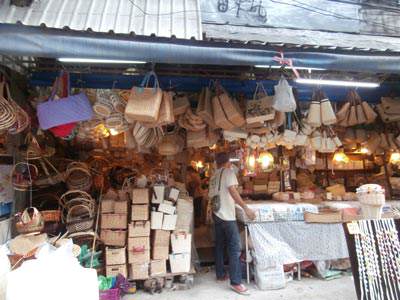
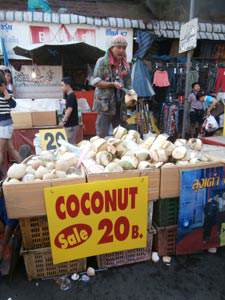
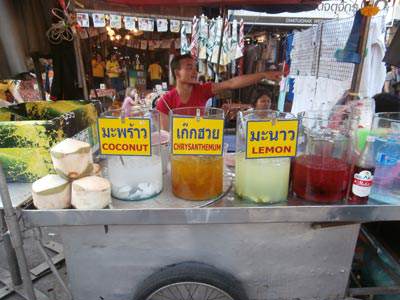
The outdoor markets are an excellent place to pick up a bargain, whether it be an Oriental antique or a beautiful cashmere pashmina. The Chatuchak Weekend Market is the best place to find good Thai handicrafts, and here I spent a blissful Sunday afternoon enjoying the throngs and festive atmosphere – and bargaining with the best of them. Apart from cheap Indian garments and plastic junk, I marvelled at finely-made Thai goods: silverware, pewter, neillo (a black metallic alloy) and celadon (ceramics), lacquered goods, hand-woven textiles and batik, rattan vines woven into baskets and furniture, and stick-puppets and pearls.
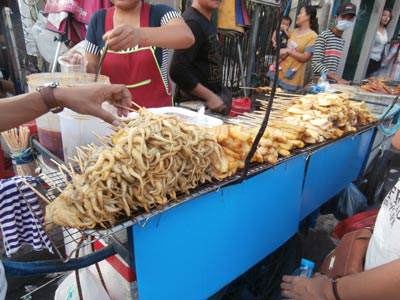
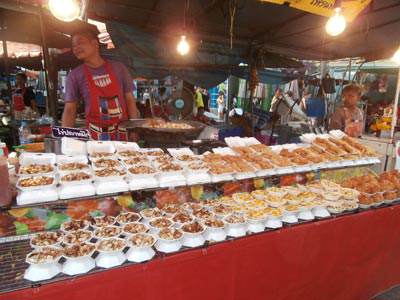
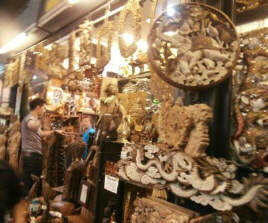
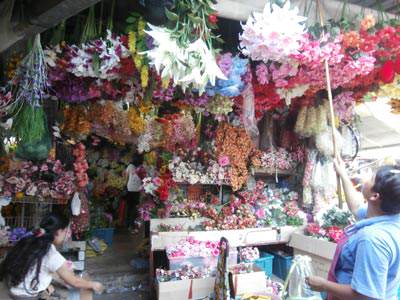 At sundown informal stalls (the night market) sprout up along such avenues as Sukhumvit, offering a vast array of Eastern goods, most of them fake copies of well-known brands such as Boss and Lacoste, fake crocodile handbags, plastic shoes, plastic orchid hair combs and nightmarish sex toys. If you are lucky, you may find a soap-carver creating beautiful flowers from cakes of soap and painting them in bright colours. These are placed into pretty lacquered round boxes, and make a delightful gift for lady friends back home.
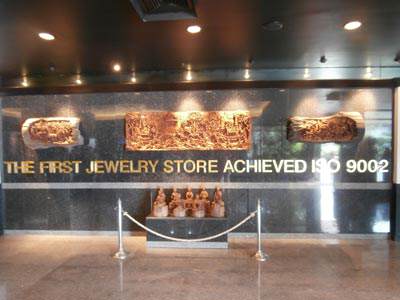 For gems and jewellery, the hotel concierge was ready with advice, (no doubt for a kick-back.) Look no further than the Gems Gallery said he, whither a shuttle would soon swiftly convey me. Before I could change my mind, and with the flourish of a cell phone, a mini bus appeared, and, like a magic carpet ride, manoeuvred nimbly through the traffic, and deposited me at the entrance to this popular emporium.
A veritable Aladdin’s cave of fabulous gems and jewellery, the Gallery was already busy with tourists in running shoes and back packs, and brisk deals being struck. After a much-needed welcome drink, I soon found myself escorted by a discreetly persuasive Jiraporn on my eager zigzag explorations through their beautifully appointed showroom – softly carpeted and musiced, and subtly illuminated, but not so subtly as to dim the glittering wares. In the centre stands an elegant fish tank in which two small sharks lazily float – the irony of which was not lost on me. Many of the colourful gems are mined in Thailand, and, ironically, set in South African gold. The designs and settings of the goldsmiths – which can be viewed but not photographed by visitors – are truly magnificent, and this craft has clearly been cultivated and honed in Thailand for hundreds of years.
It is also a well-known fact that skilful tailors in the East are adept at fitting and running up a suit in double-quick time. Sukhumvit Road is an avenue of tailors and fabric stores. Here, armed with a favourite dress, I spent many happy hours collecting quotes for the replication thereof, and browsing through fabrics. The project was a great success, and which I would recommend. But although the skill of replication is much to be admired, the price was not as good as I had hoped – or had been led to believe. Perhaps I picked the wrong part of Bangkok, or perhaps prices are better for men’s suits.
At sundown I sometimes found sanctuary in a cool and verdant park, the fumes and din of the city a muted roar, and the heat relieved by a gentle breeze. These oases offer respite for tired tourists and locals alike, not only from the heat and noise, but also from the general stink of the city. Described in various historic writings alternately as “the Venice of the East” and “a cesspool”, the Bangkok canals at this torpid latitude are the primary cause of this unfortunate side-effect of man’s interminable battle against nature. Mouth-breathing – never near a culvert or drain-hole – or a scented handkerchief, is one way to survive the smelliest city I have ever visited. The alternative is to focus on the other scents: grilled meats from the street-food barrows, tiger balm from the numerous massage parlours, and the scent of jasmine and other exotic flowers that fill the gardens and adorn the spirit houses.
As the sun sinks rapidly in the west, the call of a muezzin from a nearby mosque drifts on the air, adding to the exotic flavour of my surroundings.
Best of all, after an exciting but enervating day, a cold drink and a swim at the hotel revives flagging energy levels. There, beside the rooftop pool, with the scent of the frangipani, floating beneath the stars is a truly magical experience.
|
A well-known quote, from a silly song. For me, I thoroughly enjoyed my explorations of this fascinating Southeast Asian city, and look forward to discovering more of this “Land of Smiles” at the next possible opportunity.
* References
- Thailand Condensed – 2000 years of history and culture by Ellen Eden
2. DK Eyewitness Travel: Thailand’s Beaches and Islands (focus on Bangkok)
3. In Grandmother’s House by Sorasing Kaowai & Peter Robinson
4. Tales of Old Bangkok by Chris Burslem
5. GlobetrotterThailand Travel Guide by John Hoskin
6. Lonely Planet Pocket Bangkok
7. Handy Pocket Guide to the Tropical Fruits of Thailand and Southeast Asia by Wendy Hutton
8. The Thai Royal Family
Photo Credits: Elizabeth Handley,
and Buddha Yodfa Chulaloke portrait
Emerald Buddha -Thailand, Peter Maas
Wat Phra Keaw Ramayana Chariot
King Bhumbol and Queen Sirikit
Suvarnabhumi Airport Bangkok Thailand
Templo Wat Arun Bangkok Tailandia
Bangkok Wat Pho reclining Buddha
This article was first published in Showcook.com.
– Read Part One –

