


“Greece today is all about history and food!”Elizabeth Handley explores the cradle of Western Civilisation!– Part One – |
With more than 200,000 years of pre-history, ancient and modern history, there is a vast number of museums and archaeological sites to explore in this country. But if archaeology and culture are not your scene, there is the beautiful topography of the mainland and islands – the latter divided into six groups plus Crete – the boutiques/shopping and glorious beaches. Then there is the Greek cuisine, varying in flavour and style from region to region, and as interesting as it is delicious.
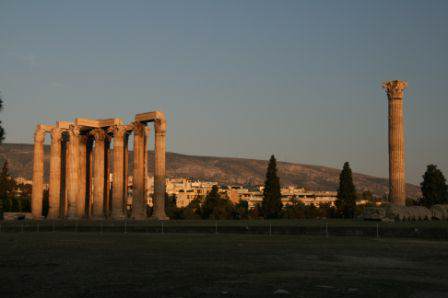
Temple of Olympian Zeus at sunset, Athens.
Athens, the capital city near the east coast of the Aegean Sea, pulsates with more life than ever since its early habitation 7,000 years ago during Neolithic times.
With a population of four million, it is now a sprawling metropolis lying in a basin surrounded by rocky hills. Approaching from the air, it is a mass of cream-and-white cubes lying in the hazy heat as far as the eye can see, relieved occasionally by a green-sloped hill topped with a church or ancient monument. Principal of these is of course the iconic Acropolis, boasting the 2,500-year-old temple of Athena – sacred goddess of Athens – the Parthenon.
Our journey of around five hours from Stockholm to Athens, with Lufthansa via Munich and Aegean Airlines, took us over southern Sweden, Germany, Prague, Hungary and the Balkan States. (The home bound flight, direct with SAS, took just under four hours.)
We were greeted on arrival at Eleftherios Venizelos International Airport by friendly staff from Fantasy Travel, an agency I had found on the internet via Matt Barrett’s Greece websites. Having been hopelessly daunted by the choice of literally thousands of islands situated in different, far-flung archipelagoes, for our short 9-day trip, I was grateful for this company’s experience and efficient organisation. Pre-paid vouchers for hotels, ferries and transfers facilitated our stay of three nights in Athens followed by two nights each on Santorini and Naxos.
After a brief introduction to our itinerary, we were transported in a mercifully air-conditioned minibus through a dry chalky landscape interspersed with pink and white oleanders, cypresses, and gnarled olive trees – very much in contrast to the watery landscape of Sweden, with its abundant lakes, lush meadows and forest greenery. The avenue into Athens is lined with orange trees, and attractive old cream-painted villas graced with pale green shutters and wrought iron balconies.
I had chosen the Byron Hotel for its quaint romantic name and excellent location in the heart of Plaka, an old district at the foot of the Acropolis, and near the marvelous new Acropolis Museum. Reasonable value for money offers basic necessities including a fridge, TV and free (sometimes dodgy) wi-fi, and a warm welcome from the owner’s son, Dimitri. Our room was Spartan but spotless (if a little “tired”), with rustic decor, tolerable beds, and a balcony with an excellent view of the Parthenon. But do not expect to swing more than a small shower-head in the minute shower cubicle. Breakfast is “continental”: coffee, orange juice, and a basket of toast and jam. This will be enjoyed on the rooftop terrace once renovations have been completed.
My erudite friend Paul is correct in his analysis of European coffee: it becomes stronger the further north you travel. Thus coffee in Stockholm (at nearly 60°N) is bound to keep one awake for a week, whilst that in Athens barely turns a hair.
Plaka has one of my favourite ancient monuments: the Choregic Monument of Lysicrates. It was built in 335/4 BC to commemorate the victors at the annual choral festival that took place at the Theatre of Dionysus. These monuments took the name of the sponsors (choregos) of the winning team, in this case, Lycicrates. The choregos paid for and supervised the training of the dramatic dance-choruses. This monument is significant as an example of the first known use of the Corinthian order on the exterior of a building:https://en.wikipedia.org/wiki/Choragic_Monument_of_Lysicrates
After our very early start, we were grateful to collapse onto our beds and escape the worst of the noon-day heat (33 degrees), and I soon dozed off to the tranquil sounds doves cooing in the eaves. Siesta time in Greece is a necessity in summer rather than a cultural moré. As in other Mediterranean lands during the sweltering summer months, many shops close for several hours during the afternoon, and the locals retire behind firmly closed shutters. Once the sun begins to set (around 8pm), the city comes alive again, and the streets fill with throngs of eager tourists seeking somewhere atmospheric and tasty for the evening.
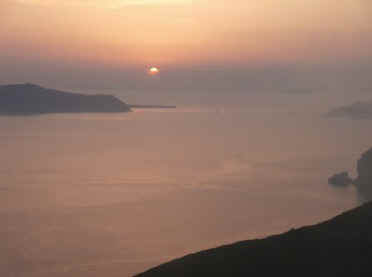
Famous sunset over the Santorini caldera.
Our first dinner was enjoyed at “Taverna Platanos” in Plaka, (Lonely Planet), a small establishment offering home-style fare. Tables with checked cloths stand in a courtyard beneath a giant plane tree and trellised vines braced aloft with a metal frame. The menu included a wide variety of traditional dishes such as grilled lamb chops and ?sh, souvlaki (meat kebabs), calamari and salads. But it was the atmosphere we so enjoyed: a balmy evening illuminated by soft lanterns, simple décor, and a giant ginger tabby winding itself hopefully around our legs.
I was amused by the street name of the place, named like so many others in Athens after some famous ancient Greek personality, in this case, Diogenes. Known as “Diogenes the Cynic”, he was a philosopher, and one of the founders of Cynic philosophy. He was born in Sinope (modern-day Sinop, Turkey), an Ionian colony on the Black Sea, in 412 or 404 BC, and died in Corinth in 323 BC. (https://en.wikipedia.org/wiki/Diogenes_of_Sinope)
Replete with veal and eggplant casserole, and dolmades and salad (flavoured with olives and thyme) respectively, complemented with a glass of wine and Mythros beer, we, like the Ancients, debated the meaning of cynicism. All around us we heard foreign languages: German, French, Italian, and, as was often the case in Greece, the unmistakable Aussie, American and Oriental twangs.
We rose early the next day, to avoid the worst of the heat and crowds, and to explore the first of the items on our accumulated list of Top Ten sights: the Acropolis. This much-revered monument is best approached through the Propylia (main gate) on the west slope, reached via the long avenue which passes the new Acropolis Museum and the Theatres of Dionysus and Herodes Atticus. (We had mistakenly entered through the exit, reached along a winding path flanked with retaining walls littered with the all-pervasive graffiti which, no doubt lewd, we were mercifully unable to read.)
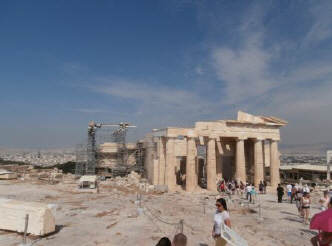
Attempts to restore the Parthenon
Having decided rather to self-guide with the pamphlet provided at the ticket booth, it was nonetheless interesting to eavesdrop on the various erudite guides taking groups around the remains of Pericles’s ambitious building project. Begun during the mid-5th century BC, much serious damage was inflicted on the Parthenon in 1687 during the Venetian attack on the Turks who had stored their ammunition therein. Attempts are being made at restoration, but the recent financial crises has halted these activities, as weed-ridden equipment and rusty cranes attest.
The Acropolis functioned for us rather like Table Mountain in Cape Town: an easily visible landmark by means of which to navigate our way around the city, and back to our hotel.
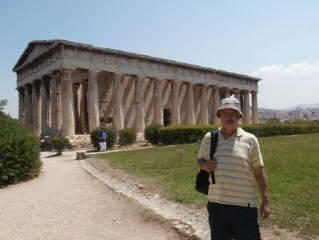
Temple of Hephaistos Ancient Agora
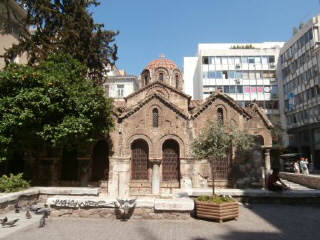
Plateia Monastirakiou Ermou St Athens
It’s not easy to decide which sights to see of the Glory that was Greece – agoras, temples, museums and monuments – in a limited space of time.
We chose the Ancient Agora, with the Byzantine Church of the Holy Apostles of Solakis, and the Temple of Hephaestus – the best-preserved Doric temple in Greece, dedicated to the god of fire (or metallurgy). The freeze on the eastern side of this temple depicts the nine labours of Heracles. The Agora is set in a large dry area encircled with a rosemary hedge, beneath which a weary tortoise was seeking shelter from the midday sun. (Only mad dogs and tourists such as we were out at that hour.)
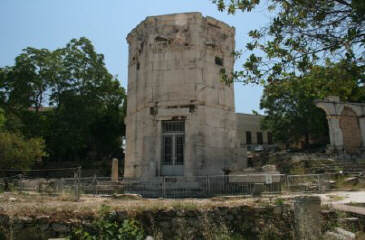
Tower of the Winds Roman Agora Athens
The Roman Agora includes the Tower of the Winds, a fascinating and well-preserved octagonal structure built in about 150-125 BC (or 50 BC – depending on the source) by the Syrian astronomer Andronikos Kyrrestes.
It is made of Pentelic marble and functioned as a sundial, water clock and compass, and the bronze triton that used to revolve at the top was a weather vane. Reliefs of the eight wind figures are carved on each side (including Boreas from the north, Notos from the south, Eurus from the east and Zephyrus from the west), and depict the patterns of the winds.
Fortified with an over-priced lunch, (salad flavoured with sesame seeds and raisins), at the magnificent new Acropolis Museum, we set about enjoying with the fascinating history displayed therein. (It’s a good idea to escape the noonday heat in one of the cool museums in the city – if not on one’s bed.) As with all the museums we visited, both in Athens and on the islands, everything is well-labeled in both Greek and English. Not for the first time was I grateful that the latter is my native tongue. The museum houses the original marbles and sculptures from the Acropolis – those not filched by Lord Elgin, which are now shamelessly displayed in the British Museum.
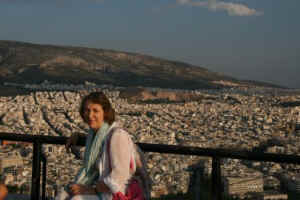
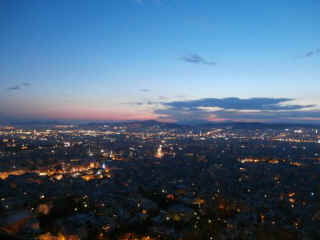
Dinner that night (a package of moussaka*, Greek salad and a glass of wine: €12pp), was spent enjoying a romantic sunset atop the famous Lycabettus Hill, reached by a short ride in the funicular. Here visitors can enjoy fabulous panoramic views over the city. A wedding service had just finished taking place when we arrived, and the valiant young bride allowed herself to be photographed with several of the Oriental tourists on the small rice-sprinkled terrace in front of the church.
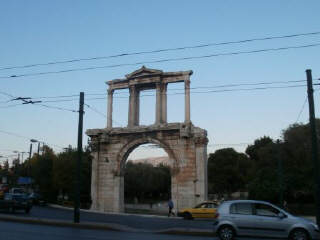
Hadrian’s Arch at sunset, Athens
Afterwards we strolled back to our hotel from the funicular station, passing through Syntagma with the Parliament building – where the high-kicking changing of the guard was taking place – and Plateia Syntagmos (Constitution Square) – the heart of modern Athens where recent violent demonstrations took place. Hadrian’s Arch, erected by this arrogant Roman emperor in 132 AD, stands guard over the plain where the magnificent remains of the Temple of Olympian Zeus lie – the largest temple in Greece – which took over 700 years to build.
The Old Royal Palace is the former royal palace in Athens. It faces onto the Syntagma Square and now houses the Hellenic Parliament. It was designed by Friedrich von Gärtner for King Otto of Greece, and was completed in 1843.
The Greek Royal Family is evidently back in Greece, after the overthrow of the monarchy in 1967. There was a military coup, followed by a failed counter-coup, and King Constantine II and his family were forced to flee into exile in Rome, and soon after to London. In June 1973 he was declared deposed by the military junta, and Georgios Papadopoulos appointed himself President of the Republic. On 29 July 1973, a questionable referendum sought to confirm the abolition of the monarchy. The dictatorship fell in August 1974 and the new regime held a fresh referendum on 8 December 1974, which confirmed the abolition of the monarchy by a vote of 69% to 30%. The deposed King has never questioned the validity of this referendum, as referenda establishing monarchy in Greece (1863 and 1935) were also accepted by his predecessors.
In 2013 Constantine II and his wife Anne-Marie announced that they were once again living in Greece. As male-line descendants of King Christian IX of Denmark, members of the dynasty bear the title of Prince or Princess of Denmark and thus are traditionally referred to as Princes or Princesses of Greece and Denmark. (https://en.wikipedia.org/wiki/Greek_Royal_Family.)
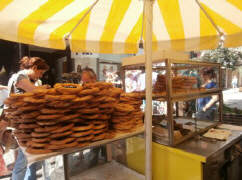
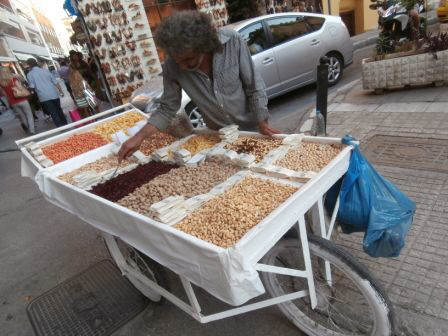
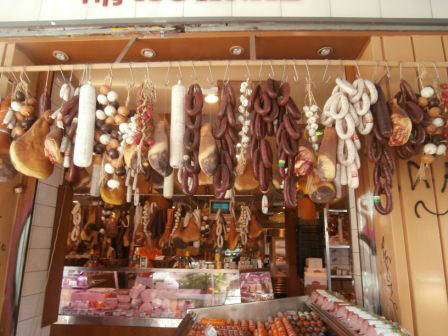
The Athens Central Market is a vibrant, “sensory and gastronomic delight” (Lonely Planet), with colourful displays of fruits, vegetables, nuts and dried fruits, cheeses, spices and herbs in packages, sausages and cured meats, olives and pickles. The meat and fish sections are housed in separate halls, where the salesmen call out their wares and housewives and restaurateurs bargain briskly.
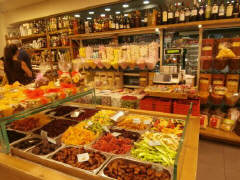
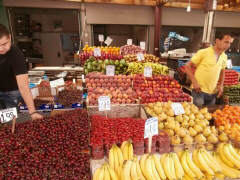
Athens Central Market
I was distressed, as always, to see large birds (chickens and pigeons) cooped up in tiny cages and standing in the hot sun on the corner of Sophocles Street near the market. I didn’t like to dwell on whether they were being sold as pets, or for the pot.
There are many weed-ridden vacant spaces in Athens, some containing the state-protected ruins of recently uncovered ancient structures, others with incomplete building operations abandoned during the financial crisis. Only the cats and sparrows now occupy these crumbling buildings overhung with vines.
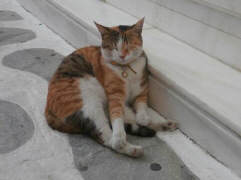 The vast gulf between rich and poor is visible in the city, with sights such as an elderly woman selling fans outside a fur boutique, while beggars hover outside glitzy gold and jewellery stores. Most walkways are paved in marble, a seemingly abundant material, and are bordered with pink and white oleander, sweet-scented coffee jasmine, and fragrant bushes of rosemary, lavender and thyme. Venerable dogs doze in doorways, always docile, and never a threat to passers-by, and everywhere there is human habitation, there are dozens of cats.
Pedestrianised Ermou Street is the most concentrated area for high-end shopping, with more shoe stores in one place than seen in any other city in Europe. There are also the usual well-known brand names (same old Benetton, Accessorize, etc.), and bakeries, crêperies, and cafés such as Kpivos exuding the delicious scents of warm caramel, and serving coffee (including cold cappuccinos piled with thick cream) and crisp, mouth-watering pastries. It’s always an enjoyable occupation people-watching on a crowded avenue in a foreign city. Athens is especially rewarding for the ladies, where fashions are colourful, and every other man is a handsome Adonis. I was surprised to see so many fur stores, and Marks and Spencer (clothes only.)
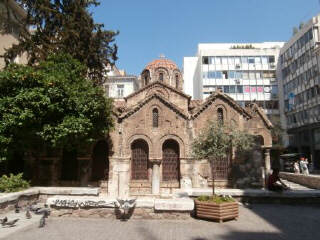
Plateia Monastirakiou Ermou St Athens
Equally surprising is the beautiful little 13th century Byzantine church of Kapnikarea in the middle of Ermou shopping mall, mercifully rescued from destruction (in the name of progress) by Athens University.
There are many interesting and ancient Byzantine churches in Athens – indeed throughout Greece. Each offer cool dark interiors richly decorated in the ornate gilt Byzantine style, with the scent of old wood and warm wax.
My long taxi-ride to Hellenic Cosmos, punted as “Worth the Trip” in my Lonely Planet guide, was almost abortive when I found it closed for “summer camps” (hordes of primary school children.) But, seeing my disappointment, the staff made allowances for me to see a small exhibition of Greek women’s clothing during the past few centuries, titled “Patterns of Magnificence”. And truly magnificent the costumes are, created using many different fabrics such as silks and cottons, and decorated with exquisite embroidery, colourful brocades and hand-made lace.
(The moral of the story is: be sure to buy guide books hot-off-the-press when travelling, or check on the internet prior to visiting a fascinating-looking place.)
See: https://www.fhw.gr/cosmos/index.php?id=1&m=1&lg=_en
Lunch-time meals, usually consisting of a simple salad with additions like sliced green apple, grated parmesan and pieces of grilled chicken, tended to be overpriced for the quality served, depending entirely upon the luck of the draw in one’s choice of eatery. Overripe tomatoes were an unfortunately frequent occurrence, as was annoying service in which tourists who had arrived after us were served first. But the friendly manner of the waiters, whose English was generally good, made up for these minor irritations.
Dinners are equally hit-or-miss. Our second night was spent on the rooftop balcony of Sissifos, named – according to Greek mythology – after a king of Ephyra (Corinth) who was punished for chronic deceitfulness by being compelled to roll an immense boulder up a hill, only to watch it roll back down, and to repeat this action forever. This taverna in the picturesque Anafiotika quarter offers a fantastic view over the city, but erratic service and food. (Sinewy lamb chops and a salad of “tomatoes” – with literally nothing else. Peter wisely chose ”Vine-farmer’s lamb”: minced lamb wrapped in vine leaves, with herbs and garlic.) Slices of complimentary nut cake flavoured with cloves and saturated in honey-syrup, made up for the heap of fat and bones littering my plate.
Anafiotika is a delightful old area in the ancient part of Athens – a labyrinth of winding narrow paths with whitewashed houses overhung with bougainvillea and brightly-coloured geraniums. They were built by stonemasons from the island of Anafi, who came to build the king’s palace during the building boom after Independence. Anafiotika is quiet and tranquil by day, but comes alive at night with singers entertaining the busy evening throng of tourists in the many-storeyed tavernas.
Other items on the “Top 10” Lists include:
1. The National Archeological Museum
2. The Benaki Museum
3. A show at the Odeon of Herodus Atticus
4. The Goulandris Museum of Cycladic and Ancient Greek Art
5. The Byzantine and Christian Museum
6. The Theseion outdoor Cinema
And slightly further afield:
1. The Temple of Poseidon at Sounion
2. Pireaus
3. The beaches near Athens.
This article was first published in Showcook.com.

