

MUSIC OF NOTE ♫
ELIZABETH HANDLEY’S
HISTORY AND APPRECIATION OF MUSIC LECTURES, COURSES AND WORKSHOPS
H. ARCHAEOLOGICAL LECTURES
- THE ORIGINS OF MUSIC and DANCE
(With PowerPoint slide presentation)
In this lecture fascinating discoveries into the origins of music – the very first known expressions in music – is explored, and, because they are so inextricably linked – the first expressions in dance as well.
It must be known that I am not an archaeologist, I am a music historian – specifically of the history of our Western “art” music. This means that my musical knowledge begins roughly during the 4th century AD with the music of the early Christian Church, which emerged sometime during the disintegration of the mighty Roman Empire. We know a little about the music and dance of some of the first great ancient civilizations, in Mesopotamia, Egypt, Greece and Rome, but only with regard to their relevance as the roots of our Western culture.
We do not know exactly when and how music and dance began; theories and suppositions abound. But we do know that musical activity and dance are the most elemental activities in life, that they have been enjoyed by all cultures, ages and sexes since the beginning of “people”, and that although their roots are manifold, certain traits are common to all peoples.
From the human voice – the first “instrument” of all, to the pipe and the drum, my discoveries are shared, and a picture emerges, of the very first expressions in music and dance – the prehistoric ancestors of Bach, Beethoven and the Beetles.


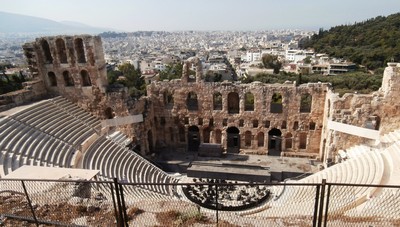
- THE MUSIC OF ANCIENT GREECE
(With musical illustrations and PowerPoint slide presentation)
The history of our Western art music is rooted in the music of ancient Greece. But not only is our link with the Greeks musical, it is also linguistic: much of our musical terminology contains Greek prefixes and suffixes, such as in the words polyphony, antiphony, philharmonic, symphony, modal, harmony, chromatic, diatonic, acoustics, homophonic and orchestra.
– Our link is also instrumental; many of our instruments today have their origins in Ancient Greece, especially regarding the basic principles of sound production: plucked strings, blown pipes and struck percussion instruments. Many features of ancient musical practice continued during the Middle Ages, and ancient musical theory became the foundation of medieval theory, as well as part of most philosophical systems.
In this lecture the music of this rich ancient culture is explored, and linked to the very bases of our modern Western musical culture. For it is in knowing something about the music of this brilliant ancient people – especially the musical practice and theory – that we can understand our own early art – or “Classical” music.
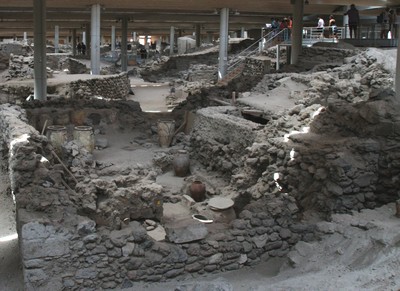
Akrotiri archaeological site, Santorini, Greece

